Scientists from the Australian National University (ANU) have designed tiny optical sensors that could be used to develop a wearable device that allows doctors to medically diagnose people’s health in real time.
The sensors – which are 50 times thinner than a human hair – could one day help doctors manage a range of chronic diseases and detect others such as diabetes much earlier than is possible at the moment.

Iowa State University researchers develop 'plant tattoo sensors' that could be used for biomedical diagnostics
“These ultra-small sensors could be integrated into a watch to literally provide a window on our health,” says Dr Antonio Tricoli, leader of the Nanotechnology Research Laboratory at the ANU Research School of Engineering.
“This exciting invention shows that we are on the cusp of designing the next generation of wearable devices that will help people to stay well for longer and lead better lives,” he adds.
Tricoli further explains how the sensors could measure very small concentrations of gases coming through your skin and breath called metabolites, allowing doctors to keep track of people’s health in real time.
“You could simply use a pulse of light to track these biomarkers of disease – there’d be no need for batteries, wires or large and expensive lab equipment,” he says.
“A wearable medical diagnostic device using our optical sensors may one day eliminate the need for blood tests and many other invasive procedures.”
Zelio Fusco, a PhD scholar in Tricoli’s lab, says the new sensors have advantages over other types being developed for wearable medical devices because they could detect metabolites in much smaller concentrations and operate at room temperature.
“The beauty of our sensors is that they are super versatile and can be integrated into different technologies for applications ranging from medical diagnosis, farming and space exploration,” says Fusco.
Co-researcher Dr Mohsen Rahmani explains how the sensors combined very small gold nanostructures with semiconductors in a way that created unique properties to enable the detection of gas molecules at very low concentrations.
“As the sensors are ultra-small and ultra-light, they could potentially be fitted to micro-satellites or tiny spacecraft that could help in the hunt for life on distant planets, by telling us if there are trace organic molecules of living organisms on distant planets,” says Rahmani.
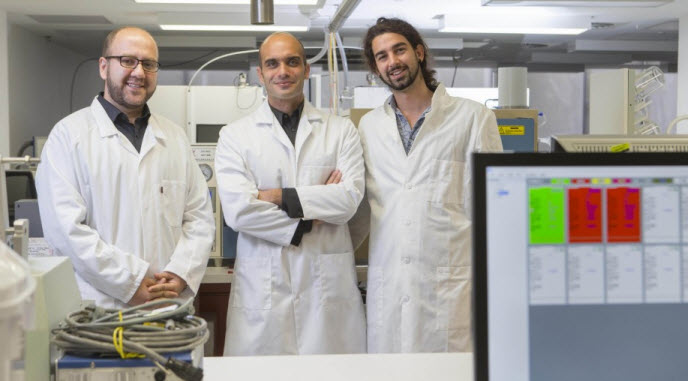
The sensors could help doctors manage a range of chronic diseases and detect others such as diabetes
More about textile sensors
Research and development concerning wearable e-textiles has been booming over the last few years. E-textiles consist of traditional fabrics woven with conductive fibres as well as electronic elements such as biomedical sensors, micro-controllers, fibre optics and wearable antennas.
Looking at sensor technology in particular, there are four general sensor structure categories, according to a research paper written by a team from the Shobhaben Pratapbhai Patel School of Pharmacy and Technology Management, Mumbai, India.
The four structures are:
1. Fibre-based, the sensor is a single yarn
2. Textile integrated, when the textile carries the function of the carrier
3. Textile structured, when all the components of the transducer are textile material
4. Textile based, when textiles are a substrate or other non-sensitive, but an inseparable compound of a transducer
Fibre optic technology, like that of the sensor developed by scientists from ANU, is widely incorporated in smart textiles to form sensors. They have many functional qualities, including low sensitivity, large band width, good accuracy, immunity to electro-magnetic waves and they’re cheap, flexible and lightweight.
Although this sector is still at a nascent stage, there are already many different types of sensors that can be used to improve healthcare. For example, there are temperature and respiration rate sensors, others that estimate a person’s pH levels, and sensing harnesses can be used to measure abdominal and thoracic movements.
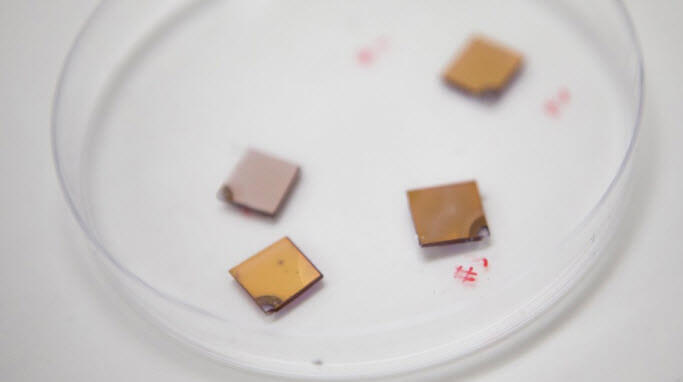
Optical sensors with a combination of very small gold nanostructures and semiconductors
Product examples
Currently there are not many products on the market, but several research and development teams are working hard to put their ideas into action.
For example, a team at the materials research institution Empa has recently designed an optic fibre that can be manufactured directly into textiles as thread to make the emitters and detectors for a heart-rate sensor. Thanks to a melting technique, the group produced what are known as polymer optic fibres in a particularly flexible form.
“Normally, these fibres, which are usually associated with communication technology, aren’t flexible enough,” says Maike Quandt, the first author of the study. “If they bend too much, they become damaged.”
The design can be produced industrially, and is able to withstand a disinfection wash cycle, making it ideal for the hospital sector.
The Oedema stocking is another example of a wearable medical sensor. The stocking monitors and measures changes in leg volume for patients suffering from oedema (fluid accumulation or swelling) of the lower limbs.
The material of the stocking is especially designed as a compression stocking that instantly measures all changes of leg expansion. The measurements are sent to a mobile phone that shows the actual changes of swelling in the legs; this information is then automatically sent to clinicians at the hospital for observation.
In other news, earlier this year researchers from Iowa State University, US, announced that they are developing graphene-based, sensors-on-tape that can be attached to plants and provide data to researchers and farmers about water use in crops. Although these were not primarily designed for the medical market the researchers have found that this technology could be used as sensors for biomedical diagnostics in the future.
A thriving market
All these new technologies means that the global medical sensor market is booming. According to research firm Market and Markets, the sector is predicted to be worth US$15.01bn by 2022 and it is expected to grow at a compound annual growth rate (CAGR) of 8.5% between 2016-2022.
Not only is the emergence of new technologies helping to fuel this growth, but so is the increase in life expectancy, the rise in demand for wearable technology and the growing ageing population of many countries across the globe.