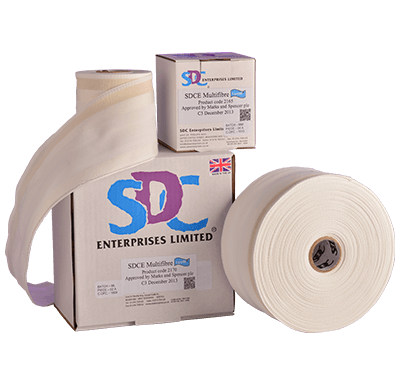
SDC Enterprises is demonstrating its innovative heritage in premium test consumables at Innovate Textile & Apparel, presenting its varied product range including its signature Multifibre DW fabric.
SDC Enterprises is a name familiar to textile testing professionals worldwide. As a manufacturer and supplier of premium test consumables for use in BS, EN and ISO test procedures, SDCE is the name specified by leading apparel brands and retailers “seeking the highest levels of accuracy and consistency in testing before they put their brand name to their fabrics”, according to the company.
SDCE products have been developed by users for users since 1926, and are now trusted by test houses worldwide as the industry standard in test consumables. A West Yorkshire company born in Bradford and now based in Holmfirth, SDCE weaves all of its adjacent fabrics in-house under rigorous quality control procedures for guaranteed consistency time and time again, the company adds.
“SDCE’s product range has become the international standard for ISO textile test procedures. As the textiles trade becomes increasingly globalised – and consumer expectation for quality rises accordingly – it has never been more imperative to standardise the colourfastness, strength and performance of fabrics for apparel on a global scale,” says SDCE.
History
Discussing its heritage, SDCE explains that it is an “integral part of its brand identity”. The company is owned by educational charity the Society of Dyers & Colourists, and the search to establish standard methods for testing colourfastness stretches back as early as 1890. Research was driven by a ‘not-for-profit ethos’, and developed in collaboration with the British Standards Institute (BSI), the European Colour Fastness Establishment (ECE) and the International Standards Organisation (ISO).
Incorporated by Royal Charter and controlled by the ISO9002 standard for quality systems, the Society has always been “uniquely placed to provide an objective view on standards development, and the quality of test products”, according to SDCE.
“High quality testing techniques, strict tolerance levels and extensive quality control procedures enable the Society to provide industry worldwide with materials for textile testing,” the company says. “Since the launch of Multifibre in the 1970s – revised as Multifibre DW in 1986 – SDCE’s produce portfolio has expanded to include a wide range of consumables for colourfastness, light fastness, strength, abrasion and pilling testing.”
Product range
SDCE’s signature Multifibre DW is an adjacent fabric comprising six different fibre components: acetate, cotton, nylon, polyester, acrylic and wool. Used in many of the ISO 105 C Series and E Series of colourfastness tests, SDCE Multifibre is said to be an essential material for the fastness tests specified by major chain stores, and offers the added reassurance of a unique SDCE security thread, according to the company.
As demand for Multifibre evolved, SDCE added two new variations to its portfolio: Multifibre LyoW and Multifibre SLW. Originally developed for British retailer Marks & Spencer in 2013, Multifibre LyoW features a regenerated cellulose component in place of the acetate strip to accurately predict the staining performance of increasing popular materials such as Lyocell, Modal and Viscose. Multifibre SLW, meanwhile, features an additional silk component, allowing the assessment of staining on silk apparel and lingerie.
Other adjacent fabrics include cotton lawn for use in colourfastness to rubbing tests and nylon 6,6 and wool for washing and wet contact tests. SDCE also offers a wide range of Martindale consumables, blue wools for light fastness tests, detergents, laboratory chemicals and assessment aids such as grey scales for assessing colour change and staining.
The SDCE difference
According to the company, “SDCE is the name specified by apparel brands and leading retailers because of its unrivalled commitment to quality and consistency”. Supported by decades of experience and backed by the ISO9002 certification for quality assurance in production, service, and installation, the SDCE product portfolio reassures customers with:
- Defined specifications
- Accredited independent testing of all products
- Full batch traceability
- Continuity provided by testing against standard masterbatches
- Certificates of conformity
- Anti-counterfeit features such as a security threads, holograms, and tamper-evident seals
“Selecting SDCE products for testing procedures is an investment into the quality control of textiles before brand value has been added. Effective testing can reduce the risk of costly claims for brands and retailers, potentially reducing returns and ensuring quality standards ahead of manufacture,” the company concludes.