Abstract
Expectations from textile materials have increased immensely in modern times. Easy care properties such as oil, water and stain repellent properties come to the forefront in many apparel and technical textile applications. The easy-care concept not only includes minimisation of ironing but also effortless cleaning of garments and the protection of garments from various oil and water-based stains in day-to-day use. Chemical manufacturers such as Sarex have made significant advances in finishing processes of fabrics, to protect them from oily stains and water. This paper gives a brief technical overview of the various C6 based water and oil repellents developed by Sarex for various textile substrates. The treated fabrics were tested for their performance and durability.
Keywords: Fluorocarbon, careguard, spray test, oil repellency
1 Introduction
Water and oil repellency are among the most common functional properties necessary for protective clothing. Water and oil-repellent finishing on textile fabrics are mostly imparted by the incorporation of low surface energy compounds. These compounds form a thin hydrophobic layer on the surface of a textile material, which changes its hydrophilic nature to hydrophobic.
Water repellency is achieved using different products, but oil repellency is attained only by fluorocarbon polymers. The intent of this finish is that drops of water and oil should not spread on the surface of the textiles, not wet the fabric, and roll off immediately.
Traditionally, silicone compounds, resins based on melamine, urea derivatives, and paraffin emulsion containing zirconium and aluminium were applied by the pad-dry-cure method to achieve water and oil repellency. Nowadays, fluorine-based compounds are used to impart a durable oil and water repellent finish on textile substrates. Chemically, fluorocarbon polymers are perfluroalkylacrylate copolymers and their fundamental structure resembles acrylic resins.
Fluorocarbon polymers are special class of polymers which represent an indispensable part of the technology of oil and water repellent finishing. Fluorocarbons contains carbon and fluorine bonds throughout the chain, which leads to relatively low reactivity and high polarity, which impart unique characteristics to fluorocarbon polymers. These fluorocarbons, when applied on the textile substrates, form a thin film around the fibres, which greatly reduces the free energy of the fibres, accompanied by an increase in the contact angle of liquids on its surface.
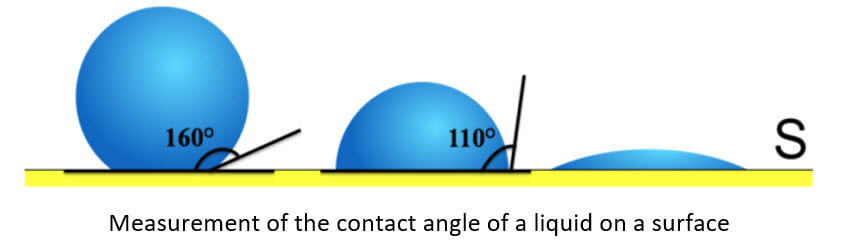
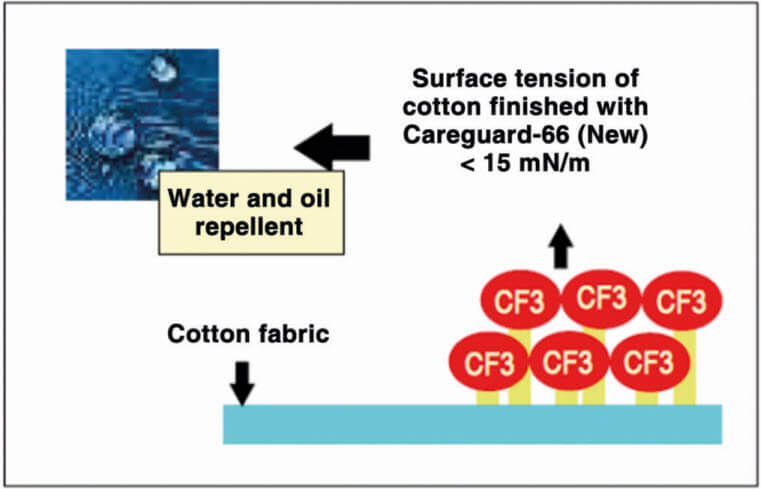
Per-fluorinated compounds typically include a fluorinated component and a non-fluorinated polymeric backbone. The fluorinated part is called the perfluoroalkyl group, which is common to all fluorochemical protectors, and the non-fluorinated part consist of an extender which forms a backbone to the fluorochemical, making it more durable and acting as an adhesive to bond the fluorochemical part to the fibre. The important feature of the polymeric backbone is that it is capable of forming a durable film on the surface of the fibre. The repellency achieved on the fabric depends upon the number of fluorine atoms attached to the carbon atoms, packing of the structure (ie if the carbon atoms are closely packed it will give better repellency) and on the linearity of the polymer (ie the carbon atoms arranged in a linear manner will give better performance than if they are branched).
The fluorine-based water and oil repellents used generally contains perfluorooctanoic acid (PFOA), an impure substance which is hard to break down due to its stable chemical structure, and there have been concerns about the negative impact of its accumulation in the body and the external environment. Taking this into consideration, primarily the US and European countries, among many others, are tightening their restrictions on fluorine-based water repellent agents, and chemicals manufacturers have been working on the development of replacement technologies.
The concerns associated with long-chain PFAAs (‘C8’) has led to shift towards shorter perfluoroalkyl chains (also termed C6). Chemically, short-chain fluorinated chemistries are closely related to long-chain homologues and are produced using perfluoroalkyl raw materials that are not expected to break down in the environment into PFOA and PFOS. Short-chain, fluorinated, durable water repellent chemistry is now promoted by the textile industry as having comparable repellency and other performance attributes to long-chain chemistry.
Understanding the above requirement to manufacture environmentally friendly fluorocarbons and keeping in mind the performance concerns of end users, Sarex has developed various oil and water repellent finishing agents, which can be applied on various substrates to meet customers’ requirements.
The following are some of the products developed by Sarex:
Careguard-66(NEW) is a new-generation water and oil repellent fluorocarbon based on C6 Chemistry. It is a dispersion of fluoropolymer, which imparts durable oil and water repellency on various substrates – viz, polyester, cotton, nylon, wool fibres and their blends – without affecting the original hand of the fabric. The performance of Careguard-66 (NEW) will be closer to that of C8 chemistry fluorocarbons.
Careguard-6NI is a cost-effective C6-based water and oil repellent, which gives balanced oil and water repellency on synthetic and natural fibres.
Careguard-314 is also a C6-based water repellent, which is cost-effective and gives excellent water repellency on synthetic fibres, and especially on nylon fabrics. It is used prior to coating so that the polymer does not penetrate to the other side of the fabric, thus keeping the fabric flexible.
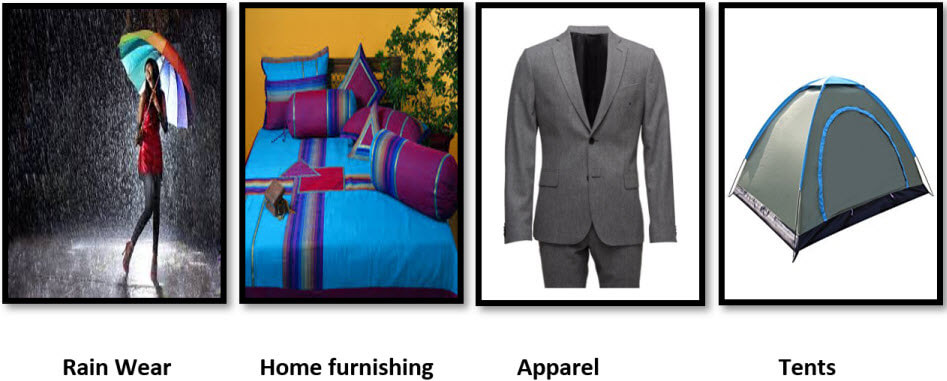
The market share of the water and oil repellent finished fabric can be divided into three categories: apparel 40% (workwear, rainwear, uniform, and outerwear); technical textiles 30% (military, nonwoven, and medical); and home textiles 30% (curtains, furniture, upholstery, and bed linen). The images illustrate some of the application areas where water and oil repellent finishes are essential.
2 Materials and methods
100% cotton, polyester and polyamide fabrics were selected for water and oil repellent finishing. The fabrics selected were washed with 1gpl Saragen-DAM to remove any impurities from the surface of the fabric. The fabrics were then finished with C6 based water and oil repellents developed by Sarex, using a padding application with 70% expression. The fabric was dried at 130°C for 2 minutes, followed by curing at 160°C for 3 minutes. The pH of the padding bath was kept acidic; ie 4.5-5.5 using acetic acid.
2.1 AATCC 118 - Oil repellency test
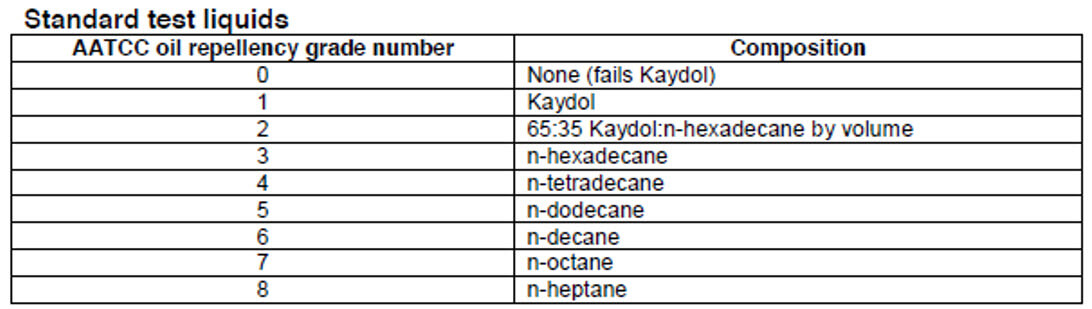
Drops of eight selected liquid hydrocarbons of different surface tensions were placed on a treated fabric and observed for wetting. The oil repellency grade of the fabric is the highest numbered test liquid which does not wet the fabric surface, with the highest achievable grade being 8. This test method is used to detect the presence of a finish capable of imparting a low energy surface on the treated fabric.
2.2 AATCC 22 - Water repellency spray test
The surface wetting resistance of the treated fabrics was tested using the water repellency spray test method. The treated and untreated fabrics were stretched tight in an embroidery hoop, held at a 45° angle in the test apparatus, and sprayed with 250ml of water through a specified spray head from a height of 150mm. The size of the wetted pattern, which depends on the relative repellency of the fabric, was compared to a standard chart of fabric water repellency ratings of zero (0), 50, 70, 80, 90 and 100. A rating of zero (0) is assigned if the fabric’s surface is completely wetted by water, whereas a rating of 100 corresponds to no wetting of water on the surface of the fabric.
2.3 AATCC 193 - Water/alcohol solution resistance test
Drops of a selected series of water/alcohol solutions of different surface tensions were placed on a treated fabric surface and observed for wetting. This test method was used to evaluate the effectiveness of the finish in imparting a low surface energy on the surface of the treated fabric.
3 Results and discussion
All the respective fabrics were treated with the above mentioned C6 based fluorocarbons developed by Sarex and were tested for their water and oil repellency and spray rating, and their results were tabulated as in the adjacent tables. The treated fabrics were also washed thrice to confirm the durability of the finish.
Table 1 shows the results of oil, water and spray rating on cotton fabric treated with Careguard-66 (New), Careguard-6NI and Careguard-314. From Table 1, it is evident that Careguard-66 (New) and Careguard-6NI show oil repellency while Careguard-314 only shows water repellency initially and after 3HL.
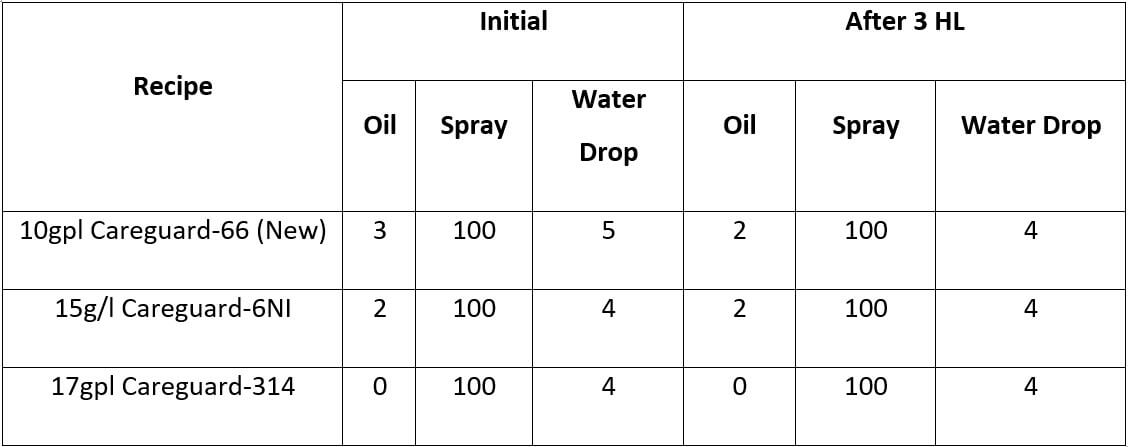
Table 1: Oil, spray and water drop rating of 100% cotton finished fabrics
Table 2 shows the results of oil, water and spray rating on polyester fabric treated with Careguard-66 (New), Careguard-6NI and Careguard-314. From Table 2, it is evident that Careguard-66 (New) and Careguard-6NI show oil repellency while Careguard-314 only shows water repellency initially and after 3HL.
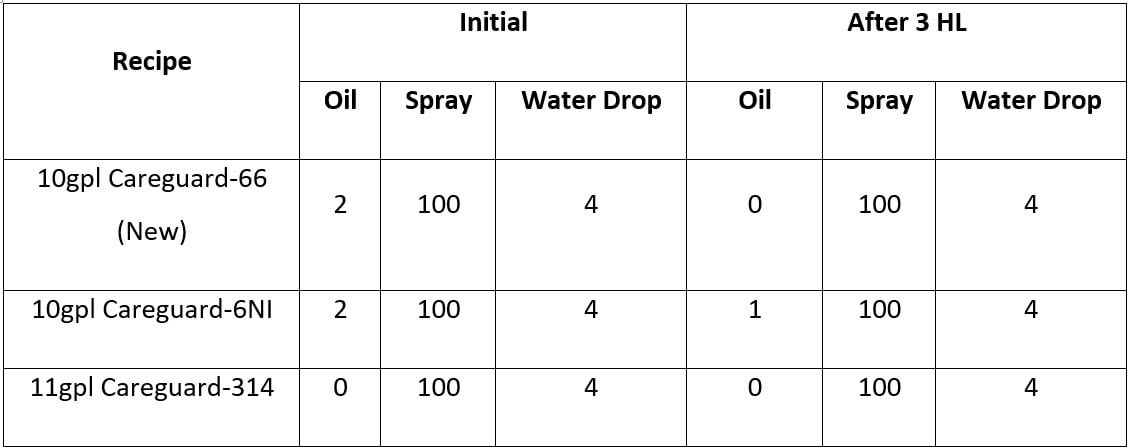
Table 2: Oil, Spray and water drop rating of 100% polyester finished fabrics
Table 3 shows the results of oil, water and spray rating on polyamide fabric treated with Careguard-66 (New), Careguard-6NI and Careguard-314. From Table 3, it is evident that Careguard-66 (New) and Careguard-6NI show oil repellency, while Careguard-314 only shows water repellency initially and after 3HL. Careguard-6NI shows better durability than the rest of the fluorocarbons.
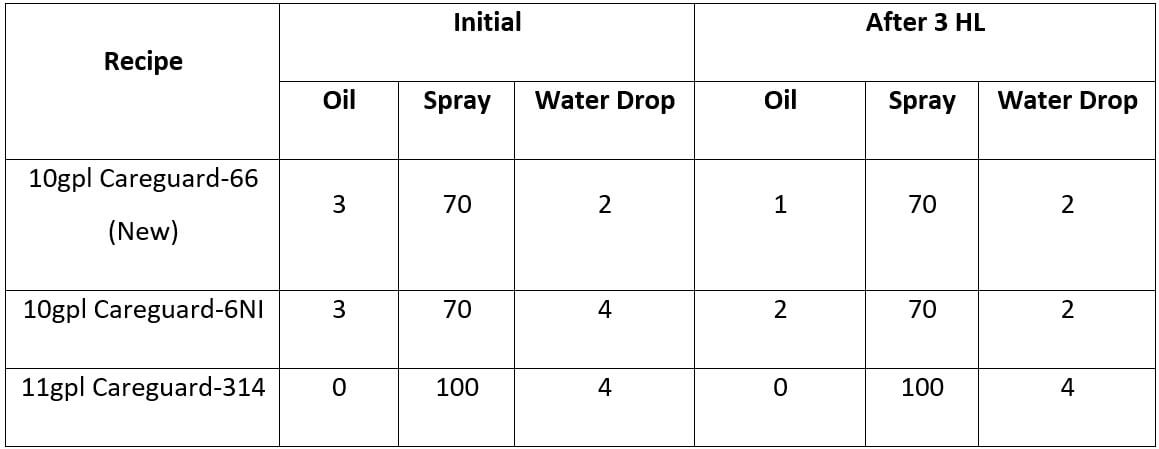
Table 3: Oil, Spray and water drop rating of 100% polyamide finished fabrics
NOTE: Please note that the concentration of the fluorocarbons in the above experiments was selected with the aim of achieving optimum results using minimum concentration. End users can use higher concentrations for better durability and performance, according to their needs.
4 Conclusion
In this paper, various textile substrates were treated with C6 based fluorocarbons manufactured by Sarex and it was found that all the products showed excellent results on respective substrates. Water and oil repellents containing short-chain perfluoroalkyl functionality are currently promoted as viable alternatives to long-chain perfluoroalkyl (C8) functionality. Short-chain fluorinated chemistries (C6) are promoted, as they are known to be less toxic and have low bioaccumulative potential. Moving from long-chain to short-chain fluorinated chemistries is a complex process that requires in-depth research and Sarex, following its objective to provide environmental friendly solutions, is at the forefront in swinging its focus to manufacture C6 based fluorocarbons which give results close to C8 based fluorocarbons.