It is common for people who work in environments at risk of exposure to toxic chemicals to require enhanced protection against a range of chemical threats. To avoid the effects of harmful substances the body must be protected from poisoning by contact, inhalation and ingestion. Current technology available on the market includes haz-mat (hazardous materials) clothing which filters and captures hazardous substances within the material. However, while using the available technology there isn’t a way of knowing if the protective clothing is offering full protection for the wearer in real time. Scrapes, rips and damage to the material can cause the wearer to be exposed to dangerous substances, which can be fatal to the human body. By informing the wearer in real time that protective clothing has stopped offering full protection, advances can be made to the level of protection from the suit, potentially saving lives.
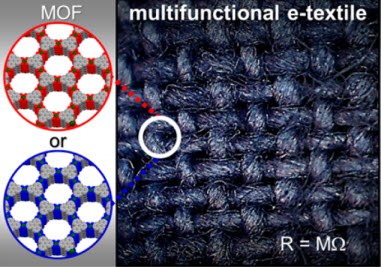
In this product innovation profile, WTiN reports on a recent development from researchers at Dartmouth College, US, who have developed a new smart fabric sensor named SOFT, which stands for Self-Organised Framework on Textiles. The SOFT device features materials known as metal-organic frameworks (MOFs) and is a conductive, porous, material sensor integrated into soft textiles. The smart fabric sensor can detect gas in real time while simultaneously capturing, pre-concentrating and filtering gases, offering great potential in applications such as haz-mat clothing. This new development could provide advanced protection for the haz-mat suit wearer, alarming the wearer if there is any tear or defect in the fabric, or if the suit is not giving the wearer full protection in any way, in comparison to passive protection that is seen in current products available on the market.
|
Purpose |
|
The development of a one-step fabrication method for novel, functional, conductive, flexible sensor material, designed to give electronic signals for the detection of chemicals such as nitric oxide (NO) and vehicle exhaust pollution (H2S) by coating both cotton and polyester fibres with two different conductive MOFs (Ni3HHTP2 and Ni3HITP2). In addition to sensing the chemicals the SOFT device is also able to capture and filter the harmful toxins. This smart fabric sensor can widely benefit wearers of hazardous material clothing by offering advanced protection against toxic chemicals. |
|
Approach |
|
Researchers at Dartmouth College have developed a method for the fabrication of flexible chemiresistive sensors supported by a textile substrate from a one-step simple approach, employing conductive metal-organic frameworks (MOFs), through the direct solution phase self-assembly of monomers; 2,3,6,7,10,11-hexahydroxytriphenylene (HHTP) and 2,3,6,7,10,11-hexaaminotriphenylene (HATP) organic ligands with metallic nickel (II) nodes onto natural woven cotton fabric and polyester nonwoven batting material. The aim was to produce Ni3HHTP2 and Ni3HITP2 coated textiles that are conformally coated with conductive MOF crystallites at the fibre level. Integration of conductive materials at the fiber level facilitates continuous conductivity while maintaining the functional integrity of the textile platform. The uniformity and successful integration of the MOFs into the textile substrates was examined by comparing the MOF-incorporated textiles and bulk MOF that had been isolated from the SOFT device reaction solution. Moreover, the sensing properties of the SOFT devices were characterised in the composition of a chemiresistor against chemicals H2S and NO as common toxic gases emitted from human industry. The researchers demonstrated the multifunctional utility of the SOFT devices in the context of chemiresistive sensing of toxic gases, as well as capture, filtration and preconcentration of gaseous analytes.
|
|
Results |
|
Chemiresistive sensors on a flexible textile substrate were fabricated by integrating conductive metal−organic frameworks (MOFs) onto a textile surface to form functional materials. Direct self-assembly of monomers produced durable large-scale electronic textiles. The conformal coatings of conductive material at the fibre level fabricated a novel SOFT device that is quick and simple to produce without any need for specially designed equipment. According to the researchers, the SOFT devices featuring MOFs can detect and differentiate toxic gaseous analytes of NO and H2S at 25pp and 10ppm levels respectively and maintain their chemiresistive function in the presence of humidity (5000 ppm, 18% RH). Moreover, they display reliable conductivity; results showed that both the SOFT natural cotton fabric and the SOFT polyester nonwoven material had a comparable level of conductivity performance. However, results also found that the SOFT devices failed to display conductivity if the MOF was not uniformly distributed. In addition, the results suggested that crystallisation of the conformal MOF coatings is imperative for the electrical and chemiresistive performances of the fabricated SOFT devices. The SOFT devices were found to have stability to washing, while also maintaining the flexible properties of the original material after coating. These smart fabric sensors were able to be bent, twisted and wrapped around curved surfaces without any loss of conductivity. Findings also displayed the SOFT devices to be stable in heat, have good shelf lives and retain a full range of utility under humid conditions. |
|
Impact |
|
The fabrication of SOFT devices helps to give further understanding of the potential properties of conductive MOFs. Although the technology requires further developments, in the future this technology has the potential to be used in a broad range of areas such as sensing applications ranging from real-time gas detection in protective clothing, to electronically accessible adsorbent layers in PPE such as gas masks. The authors are also hopeful that the fabrication of this technology gives potential for application in other systems, due to the possibility for producing a variety of novel, multifunctional conductive textiles with highly engineered properties, for use in many unique applications in wearable and portable devices. |
Reference
- Wei Q. Functional Nanofibers and Their Applications. Woodhead Publishing; 2012.
- Smith MK, Mirica KA. Self-Organized Frameworks on Textiles (SOFT): Conductive Fabrics for Simultaneous Sensing, Capture, and Filtration of Gases. J Am Chem Soc. 2017;139(46):16759-16767. doi:10.1021/jacs.7b08840
Copyright © 2017 American Chemical Society