The wearable technology and smart textile industries have long looked at energy supply as a means of realising product innovation. The realisation is slow but the energy itself is becoming one of the most exciting areas of research and development within smart materials and systems.
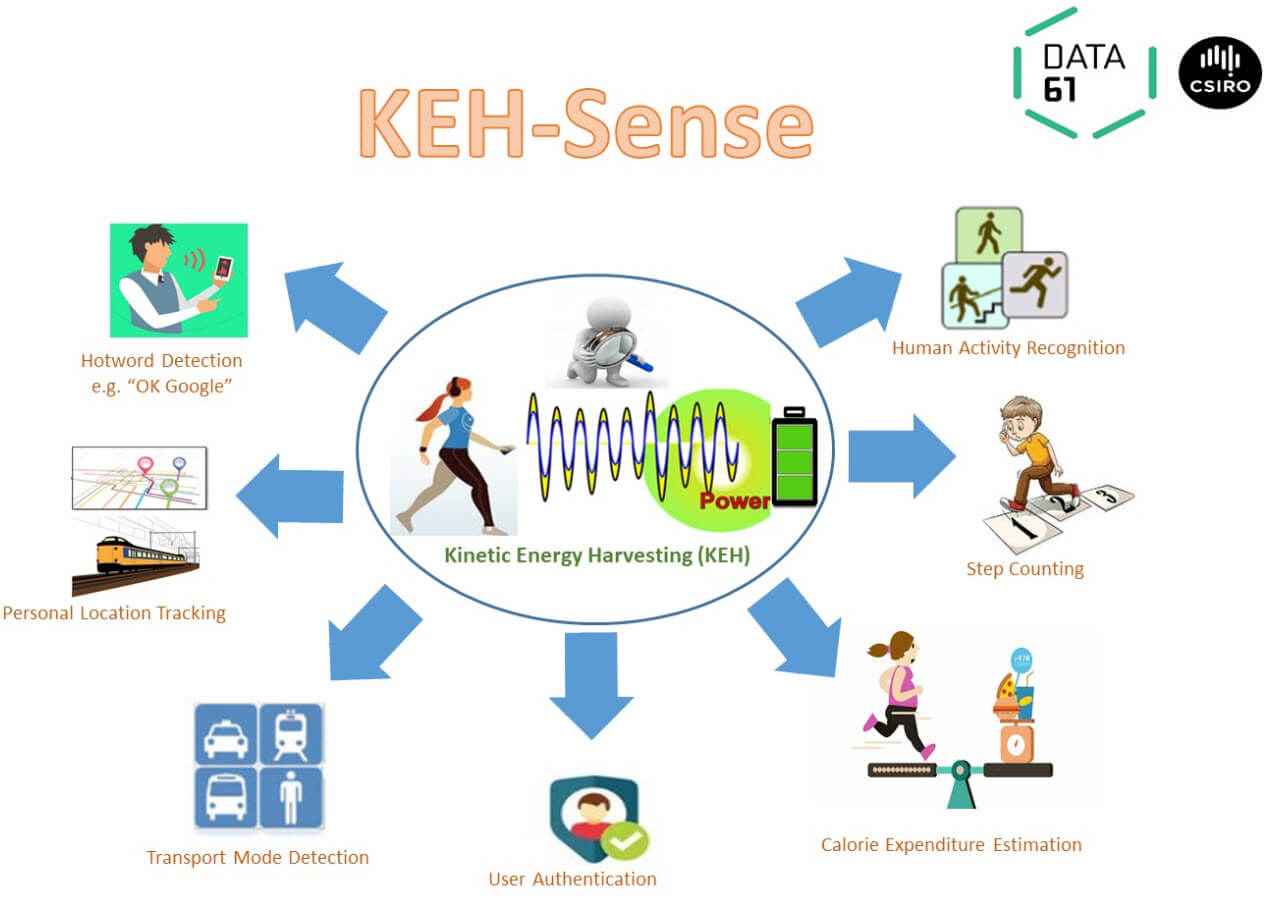 KEH-Sense addresses two market needs in one product
Image credit: Marie O’Mahony
Through the 1990s, the much-anticipated lithium battery was seen as a panacea for the energy needs of wearable technologies. Once established, it was clear that the game had shifted, and the lithium battery was no longer enough. Solar, wind, ocean and kinetic energy have grown alongside new technical capabilities in fibre, fabric, lamination and other coating and finishing technologies. In addition to this, sustainability and a more user-centred design approach have given rise to the demand for energy sources that can offer lightweight, flexible, high energy yielding and low environmental impact power supplies.
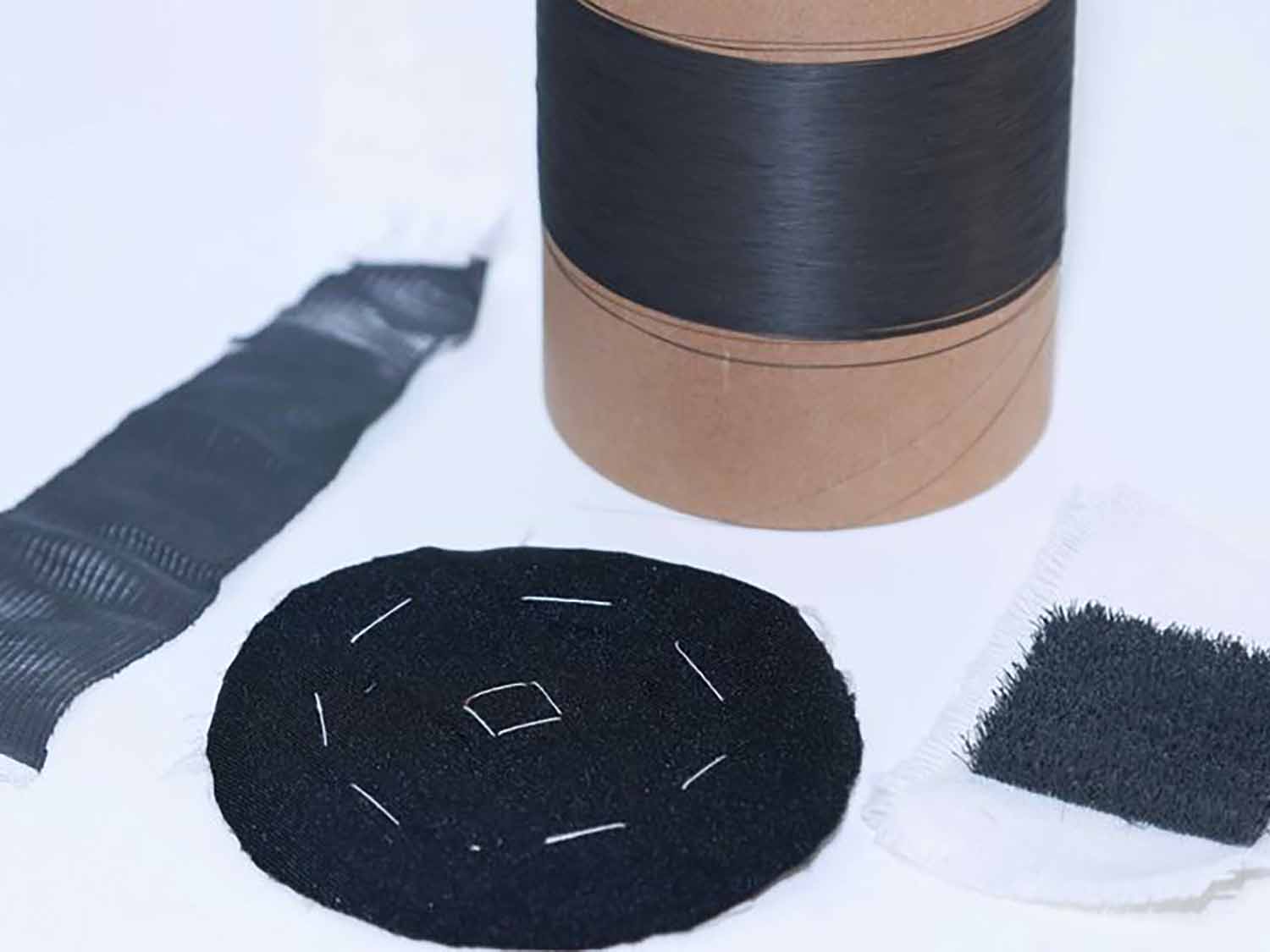
In Germany, the Mechanical Engineering Industry Association (VDMA) awarded the Walter Reiners Foundation 2018 dissertation prize to Dr Benjamin Weise, a graduate of the Institut für Textiltechnik (ITA) of RWTH Aachen University for his dissertation ‘Development of graphene-modified multifilament yarns for the production of textile charge storage devices’. Weise has developed a novel polyamide and graphene fibre and further processed them into textile surfaces. The fibres offer a high-performance charge storage area that allows them to be used as double-layer capacitors – or super capacitors, sometimes shortened to simply supercaps. These offer a significant advantage over the more conventional lithium-ion batteries, bringing a higher power density and a longer lifespan because of the absence of a chemical reaction. This allows for a charge storage device to be integrated directly into a textile without the need to sew in a rechargeable battery. The fibre has the potential to accelerate product developments such as textile defibrillators, where even small energy advances can make a significant difference.
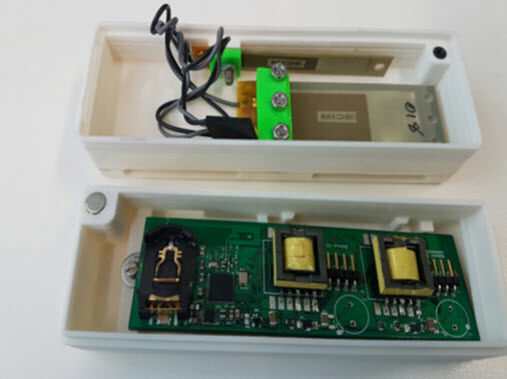
KEH-Sense prototype
Kinetic Energy Harvesting (KEH) devices are now appearing on the market, with AMPY MOVE offering a portable smartphone battery that charges as the wearer moves. Gait recognition can be categorised into three areas. The first is vision-based, where information is captured at a distance using a camera before using additional processing technologies to extra gait data from the images collected. The second method is floor-based, where sensors are installed beneath the floor surface to record data for further processing. The third method uses wearable sensors, with accelerometers worn on different body areas. KEH-Sense addresses two market needs in one product offering wearables that are self-powering alongside a user-identification system. The joint research project includes participating researchers from universities in China and Australia as well as Australia’s Commonwealth Scientific and Industrial Research Organisation (CSIRO). The research uses KEH to harness energy from the body’s movement to power devices.
In wearable technology for healthcare the use of accelerometer-based user authentication systems for gait analysis is attracting a great deal of interest. However, accelerometers have been found to reduce the battery life of wearable sensors which is proving a significant obstacle to progress in the field. KEH-Sense looks to address this by eliminating the need for accelerometers relying instead on inferring human context information directly from the ambient vibrations that generate energy in a different way producing distinct energy generation patterns in the KEH circuit.
“Because no actual sensor such as accelerometer is needed, a significant percentage of the limited harvestable energy can be saved, making significant progress towards self-powered autonomous wearables,” according to CSIRO. While an issue for all wearables, healthcare products are particularly vulnerable. Implantable Medical Devices (IMDs) for example have a long lifespan but short battery life with surgery needed to replace the battery. KEH-Gait is a proposed novel gait-based user identification system intended for mobile healthcare and powered by KEH. Initial tests use two different energy harvesting systems, piezoelectric and electromagnetic. Both were found to offer slightly less accuracy that accelerometer-based gait recognition, by around 6%. This is being overcome by the introduction of the novel probability based Multi-Step Sparse Representation Classification (PMSSRC). This combines data gathered from multiple steps to bring the accuracy back in line with the accelerometer method. The KEH-Sense researchers are also looking at the field of Biometric Cryptosystms (BCS). This has the potential to utilise biometric data to generate a unique cryptographic key.
Wearable technology for workwear addresses the need for compliance, safety and efficiencies that all require data collection. Some of the earliest devices augmented wayfinding and remote data access, while more recent developments monitor heart rate, fatigue levels and alert to environmental and operational risks. International ThermoDyne has developed PhelTex to harvest the wearer’s body heat and movement converting the energy into electricity. The potential it brings to workers in hazardous or remove environments is as a power source incorporated into clothing that eliminates the need to recharge batteries. It can also provide heat or cooling on demand. SolePower’s patented EnSoles has received the support of the US Army and the National Science Foundation and harnesses power from the wearer’s movement. Incorporated into smart boots, the market it is aimed at is defence, industry and first responder. Using multiple sensors location, motion and environmental conditions can be monitored alerting the wearer and colleagues if a worker has stopped moving or has encountered a life-threatening situation.
At Taiwan’s Industrial Technology Research Institute (ITRI) researchers are addressing firefighters need for mobile lighting without adding to their payload that can exceed 30kg. They have developed a Fluid-Driven Emergency Lighting (FDEL) device that can be added to the firehose during use. The high-illumination LED is powered by micro-hydropower so there is no need to carry additional lighting equipment or batteries. The technology works by generating electricity as the water flows through a turbine blade positioned within the microgenerator. The lighting can operate for around one hour using stored power. The system also has applications as part of a fire sprinkler system within buildings, helping both firefighters and trapped occupants to safety.
Not all energy innovation excludes Lithium batteries, and the Soteria Battery Innovation Group is focused on offering an improved architecture for lithium ion batteries. The problem they are addressing is thermal runaway, fires and explosions that they attribute to a combination of metal needed to process the electrodes through coating operations and the relatively low melting point of plastic separators. Based in Greenville, South Carolina, the company has developed a Dreamweaver battery separator using a thermally stable nonwoven made from advanced fibres to replace the plastic separator located between the anode and cathode. The nonwoven’s increased stability means that it will not melt or shrink under the intense electrical current that is associated with an internal short and so greatly enhances the safety of the battery. The development is an important on for wearable technology as well as the nonwovens industry as it looks to develop a stronger presence in durable rather than single-use markets.
The idea of storing a power source for wearable technology within a discrete pocket or waistband is fast disappearing. The consumer expects flexibility and balanced weight distribution throughout, as does the worker operating often in extreme environments where comfort is not seen as a luxury but a factor that impacts on performance and wellbeing. The result is that innovative energy systems are impacting product at a much earlier stage in the design process and even prompting new designs and products.
Marie O’Mahony writes and consults for the textile and apparel industry. She is the author of several books on advanced and smart textiles published by Thames and Hudson.