Gone are the days of fiddling with laces now that Nike and Puma have both recently launched their self-lacing shoe technologies.
Nike Adapt
First up is Nike. Back in 2016, the company launched its HyperAdapt 1.0 technology, a first attempt at a power lacing performance shoe. Now three years later, the company has found its most advanced fit solution to date – the Nike Adapt.
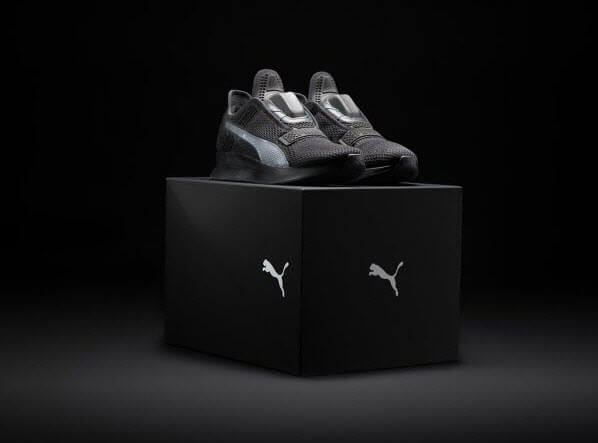
Nike Adapt is a platform that creates a custom fit by combining a power-lacing system, an app and firmware. Currently, this technology is featured in the new Nike Adapt BB basketball shoe.
“We picked basketball as the first sport for Nike Adapt intentionally because of the demands that athletes put on their shoes,” says Eric Avar, Nike VP creative director of Innovation.
“During a normal basketball game, the athlete’s foot changes and the ability to quickly change your fit by loosening your shoe to increase blood flow and then tighten again for performance is a key element that we believe will improve the athlete’s experience.”
So how does the shoe work? Well, when a player steps into the Nike Adapt BB, a custom motor and gear train senses the tension needed by the foot and adjusts accordingly. The tensile strength of the underfoot lacing is able to pull 32 lbs of force to secure the foot throughout the range of movement (that’s roughly equal to that of a standard parachute cord).
What’s more, players can input different fit settings depending on different moments of a game by manually touching or by using the Nike Adapt app on a smartphone. For example, during a timeout, a player can loosen the shoe before tightening it up as they re-enter the game. In a forthcoming feature, they can even prescribe a different tightness setting for warm-ups.
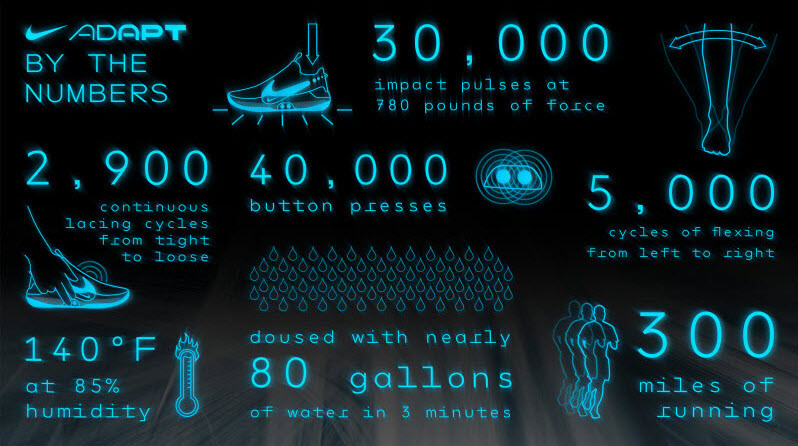
The Nike Adapt BB has been put through many tests, including impact tests, intense temperatures, end-of-life tests that lasted tens of thousands of cycles long, waterproof tests to simulate sweaty feet and so on.
The ultimate stamp of approval though comes from players in the highest levels of the sport.
That’s why the Nike design team invited a group of professional basketball players, including Boston Celtics small forward Jayson Tatum, to Nike World Headquarters in Oregon, US, to trial the shoe.
“Bill Bowerman’s original insight was that fit is the foundation of athletic performance,” says Avar.
“The Nike Adapt BB helps the athlete find their custom fit and provides uncompromising lockdown, feel and traction throughout a game, but we knew it would only be validated once the game's best players tried it out.”
The first FitAdapt technology will be available in the Nike Adapt BB shoe in February 2019.
Puma’s Fit Intelligence
Towards the end of January, Puma also introduced its new ‘self-lacing’ technology platform – Fit Intelligence (Fi).
The first Fi footwear style to be launched is a training shoe that is made for workouts and light running.
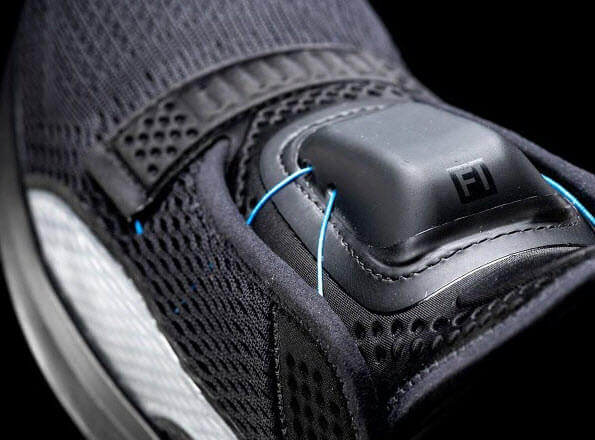
It employs a micromotor to power a configured cable system that ‘laces’ the shoe by swiping on the Fi module up or down. It comes with a smart sensing capability that learns the shape of the foot of each user and adapts the fit of the shoe to the individual.
Athletes can also monitor, adjust and finetune fit through a smartphone app, or even make adjustments with their Apple watch.
“We have created a product that speaks to the future of sport which is life in motion,” says Charles Johnson, Puma’s global director of Innovation. “It’s fast and changing all the time.”
The training shoe contains a breathable upper for more comfortable training and also comes with an industrial grade fibre support system, strategically placed for optimal hold and a forefoot lockdown band.
“As a global investor in wearable technologies, I know how hard it is to get a product like Fi right and after my first week with the shoes, it’s clear that Puma is taking this platform very seriously and I’m impressed,” says Bay McLaughlin, a global technology investment expert who has tried Fi.
For the first time ever, Puma will allow tech-savvy people to participate in beta testing of Fi to help the company think of ways of making it even smarter and more powerful.
The testers will be able to give feedback on the usability, design, engineering, and wearability of the shoe.
Anyone can sign up for the Fi Beta Test programme through PumaTrac, Puma’s training app which is available on the App Store and on Google Play. Puma will announce on PumaTrac and its website when and how to sign up.
The Fi training shoe will be available to consumers in 2020.