
Every year, tons of old textiles that cannot be reused or sold end up in incineration plants or in landfill. The textile industry is growing, and the proportion of multi-material textiles, ie mixtures of various natural and artificial fibres, is steadily increasing too. Society and lawmakers rightly demand rapid technological solutions for the recycling of this kind of waste to protect the environment and save material resources.
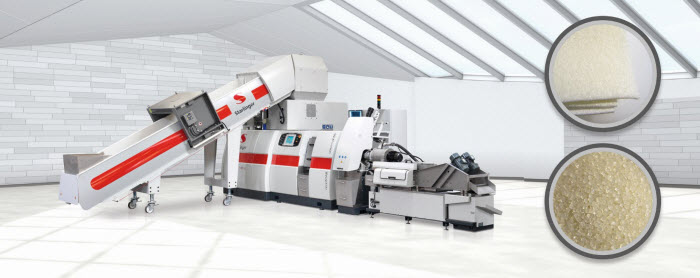
Processing of technical nonwovens on the recycling line recoSTAR universal. ©Starlinger
Within the textile network PlasTexTron, Starlinger recycling technology is now searching for an ecologically and economically sound solution for the recycling of mixed textile waste of multi-material composition.
The company has joined the COIN-project TEX2MAT – which is led by the Plastics Cluster of ecoplus, the business agency of Lower Austria, and funded by the Austrian Federal Ministry for Digital and Economic Affairs (BMDW). The project aims at efficient recycling that yields a product with virgin-like characteristics. Three universities and eight Austrian companies are also involved in the COIN-project TEX2MAT.
The project addresses the recycling of different kinds of old textiles that consist of a mixture of polyester and cotton.
The first step is the enzymatic separation of polyester and cotton in a procedure developed by the Viennese University of Natural Resources and Life Sciences. After appropriate reprocessing, the materials are then reused in new products.
The input material is supplied by the companies Herka Frottier, Salesianer Miettex and Huyck Wangner Austria (Xerium Group), which are all located in Lower Austria. Starlinger recycling technology – a business unit of Starlinger, which manufactures recycling lines and has already developed solutions for closed loop production in the field of polyester textiles – provides recycling services and expertise for the project. To achieve an optimal result, regular controls of the material properties are performed by the University of Leoben.
The project partners are working specifically on the following case studies:
• Mixtures of polyester and cotton from the production of towels as well as old textiles in the form of bed linens and working clothes are shredded by Starlinger recycling technology in Weissenbach and then undergo enzymatic treatment at the Technical University of Vienna. The goal is to develop a sample process for closed loop production.
• Technical nonwovens made of polyamides are shredded and turned into regranulate by Starlinger recycling technology. Thermoplastkreislauf GmbH then adds substances such as glass fibres, additives and/or colours as needed (a process commonly known as compounding). The companies Multiplast Kunststoffverarbeitung and Fildan then use this customised material in the production of highly technical plastic parts such as components for fire extinguishers or bra fasteners.
The project TEX2MAT started in November 2017 and will be running over the course of two years. The project partners meet in regular intervals to align the individual steps and discuss the overall progress. In September 2018, TEX2MAT will be presented at the international fibre congress GFC in Dornbirn, and initial results are expected to become available until K show 2019 in Düsseldorf, Germany.


