The Australian wool market continued its downward trend this week, recording overall losses for the fourth week in a row.
The Australian Wool Exchange (AWEX) Eastern Market Indicator (EMI) fell by 16 cents (0.8%) for the week to close on 1,963 cents per kilo clean on Thursday 21 March. However, in US dollar terms, the EMI was up by 6 cents (0.4%) to finish on 1,403 US cents.
A strengthening in local currency appeared to have an effect on the market. The Australian dollar against the US dollar reached 71.62 US cents on Thursday, its highest level since 27 February, before closing on 71.45 US cents, 0.86 cents (1.2%) higher compared with last week.
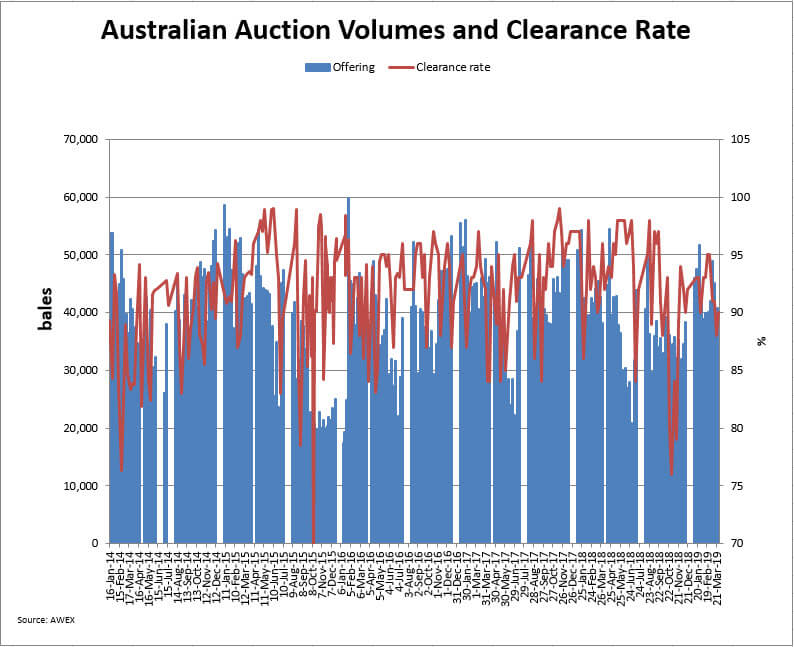
This week’s total national offering was 43,129 bales, compared with 40,785 bales last week. The clearance rate this week was 89.7%.
Sales were held at all three selling centres on Wednesday 20 March and Thursday 21 March. On Wednesday the EMI fell by 1 cent to 1,978 cents and in US dollar terms rose by 3 cents to 1,400 US cents. On Thursday the EMI declined by 15 cents to 1,963 cents and in US dollar terms rose by a further 3 cents to 1,403 US cents.
Analysts noted that the market got away to a positive start in the South and the West, but began with a weaker performance in the North, which reflected a generally poorer offering. Thursday’s market saw falls across all centres, although this was strongly influenced by the strengthening of the Aussie dollar.
AWEX reported that a continually diminishing supply of good style wool, in particular those with favourable additional measurement results, attracted excellent competition and as a result recorded minimal losses. However, due to seasonal conditions, a large part of the offering was lower style types, many of which also possessed poor additional measurement results.
Wool with styles 6 and 7 made up 15.4% of the merino fleece offering, the highest level since June 2010. Due to the prevalence of these wools, buyers again struggled to average them into their purchases. The result was the continued discounting of these types as the series progressed, and by the end of the week the prices being achieved on these lower style types were generally 20 to 40 cents below those achieved at the previous week’s sale. It was these price reductions that were the driving force behind the losses recorded in the average AWEX individual Micron Price Guides (MPGs).
Among the MPGs for the merino types, 16.5 microns fell by 13 cents (0.5%); 17 microns was down by 5 cents (0.2%); 17.5 microns declined by 9 cents (0.4%); 18 microns decreased by 4 cents (0.2%); 18.5 microns was down by 13 cents (0.6%); 19 microns fell by 8 cents (0.3%); 19.5 microns lost 12 cents (0.5%); 20 microns fell by 9 cents (0.4%); 21 microns decreased by 2 cents (0.1%); and 22 microns declined by 11 cents (0.5%).
AWEX noted that the skirting market behaved similarly to the fleeces. Better style lots with less than 3% vegetable matter (VM) were keenly sought after and were generally only 20 to 30 cents easier. Buyers were less keen on the lesser style wools and lots carrying in excess of 5% VM, and as a result these types fell by 50 to 80 cents.
The crossbreds defied the trend of the other sectors, managing to record small gains for the series, generally between 10 and 20 cents. Among the average AWEX MPGs for the crossbred types, 26 microns fell by 3 cents (0.2%); 28 microns was up by 19 cents (1.7%); 30 microns increased by 8 cents (0.9%); and 32 microns was up by 14 cents (2.3%).
AWEX reported that the total value of the wool sold this week was AU$81.5m (AU$2,106 per bale), taking the season total to AU$2.471bn (AU$2,191 per bale). Buyers for China were dominant, with support from buyers for India and Europe.
The national offering for next week (Week 39) is forecast to be 38,950 bales, while the projection for Week 40 is 37,787 bales and Week 41 is 35,735 bales.