
The relationship between our clothes and our health is growing ever stronger, with new material technologies offering increased potential. Andy Rhodes speaks to TexDel’s Jordan Schindler about his company’s medical technology platform.

Jordan Schindler, CEO, TexDel
In recent years, researchers and manufacturers have been searching for better ways to optimise textile materials in order to maximise their potential.
For example, work has been done to explore the use of graphene in clothing to enhance strength, while other teams have engineered garment materials from mycelium in a nod to the eco-friendly future of fashion production.
Other teams have sought to increase the functionality of the base materials themselves, resulting in a completely redefined garment. North Carolina-based start-up TexDel has done just that.
Based in the Manufacturing Solutions Center in Conover, North Carolina, TexDel has developed the Nufabrx platform, which allows for the controlled delivery of vitamins, supplements and medications through a garment, directly to its wearer.
The technology is the brainchild of Jordan Schindler, the company’s CEO, who developed the idea after learning that pillowcases are a primary cause of bad skin. “Most people don't realise, but pillowcases are one of the leading causes of acne,” he says. “So, I went to the dermatologist and I was actually recommended to wash my pillowcases two to three times per week, which as a college age kid was just never going to happen, but it got me thinking about how people could benefit from a garment or fabric – something that contacts your skin all day, every day.”
He continues: “I teamed up with a couple of drug delivery scientists and created a way to deliver a controlled dose of an active ingredient, such as vitamins, supplements and medications, through a yarn and subsequent garment; and that is really how the company started.”

TexDel receiving the AFFOA People's Choice Award. Pictured L-R: Yoel Fink, CEO, AFFOA; Jordan Schindler; and Justin Jed, TexDel
Seeking expertise
At the time, the company was based in an area of the US not known for its textile expertise, and in order to move to the next level, Schindler knew that a move was required. “The company started in Seattle and we quickly realised that we needed to relocate to North Carolina, which is the hub of the US textile industry.”
He adds: “We are based in a facility called the Manufacturing Solutions Center, which is designed to commercialise new textile technologies. They have textile testing, high-speed knitting machines, antimicrobial testing, but more importantly they have a lot of the talent that we needed to scale the business.”
Seeking the right talent has been key to the success of the company, with the team boasting a wealth of interdisciplinary expertise, as Schindler explains. “Our team is a mix of textiles and pharmaceuticals. Our head of production was at Unifi, one of the largest yarn manufacturers here, for a number of years, but we also have people with backgrounds in pharmaceuticals. We have a couple of drug delivery scientists, including an MIT PhD, that have numerous approved patents and FDA drugs on the market, and really understand how to create a new textile and pharmaceutical product.”
He notes that the differing backgrounds of his team have offered perspectives from sectors not normally associated with garment manufacturing. “One of our PhD scientists worked with Kimberly-Clark, Honeywell, and Procter & Gamble,” says Schindler. “He also worked on diapers – which is an interesting parallel because they try to take moisture away from the body, all while trying not to dehydrate the skin.
“We are trying to bring moisture back to the body, so there were interesting synergies there. Our team is a mixture of textiles and pharmaceuticals, which are the two industries that we are really smashing together to create the technology.”
Together, the team has successfully developed a technology platform that offers wide-ranging potential for the drug delivery industry, whether it be simple skin moisturisers or more serious medication. “Our technology allows for the controlled delivery of anything from creams and pills to transdermal patches, really anything that you can get over the counter at a drug store,” says Schindler. “We’re starting in topical creams or pain relief, such as BioFreeze. But we can also do things like muscle recovery, moisturising, anti-cellulite and anti-ageing at the same time.”
Consumer focus
He explains that the team is working to solve problems for the consumer and make the daily task of taking medicine much simpler, particularly for those who may suffer from diseases such as Alzheimer’s. “Our core model is that we are simplifying consumer health and wellness,” says Schindler. “So instead of having to remember to take your medication or take a pill, all you have to do is get dressed in the morning – and that, we feel, is the value we are creating for the consumer.
“There’s this statistic I like that says 85% of people believe good health contributes to their definition of success in life, but 75% are non-compliant when it comes to taking their medication. Whether that’s applying cream every couple of hours or taking a pill as often as they should.”
The technology has been in development for the past five years, with the company working out how to deliver the correct dosing, and perhaps more importantly, delivering a textile product the consumer would want to wear.
“Even if you can deliver medication but it doesn’t feel like a garment that someone wants to wear, then it really doesn’t matter,” says Schindler. “Or if the garment can’t withstand consumer wash cycles, it doesn't really matter.
Earlier this year, Greenville, SC-based garment company Kentwool developed the SensationWool Sock, which the company states is “the first and only sock with fibres treated for pain relief.”
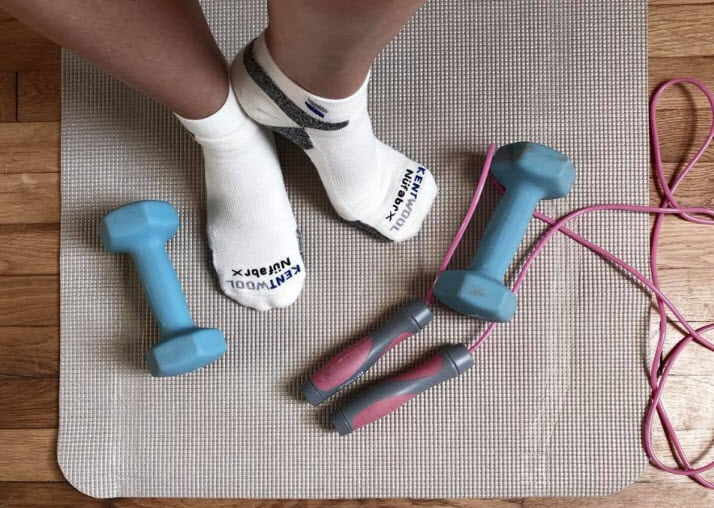
The capsaicin SensationWool pain relieving sock from Kentwool.com sold out in less than one week
“What we have developed is this technology where we can deliver a controlled dose, the same as you would get from a pill or from a cream, and we can show exactly how many milligrams you are getting every hour as you are wearing that garment,” he adds. “That is what has taken so long to develop, to get that delivery system just right where we are able to incorporate that within a textile product and deliver that controlled, sustained dose over a long period of time.”
Identifying how to apply its technology to different types of yarn has also been a challenge for the company. “Right now, we have been using primarily synthetics such as nylon and polyester. We’ve also been trying to get into some natural fibres like cotton and wool. What we do is treat the yarn product itself. Then you are left with a package of menthol yarn or moisturising yarn, which can be knit or woven into any end garment.
“So, our yarn might be turned into a sock for pain relief, it might be turned into tights and leggings with a moisturising benefit, or even as crazy as an automotive company trying to do steering wheel covers with caffeine to keep drivers awake,” he continues. “There’s a whole list of potential use cases that can result from our technology.”
In a real achievement for Schindler and his team, the company was recently awarded a US$1m grant from the AFFOA (Advanced Functional Fabrics of America) and the US Department of Defense in order to further the development of the technology and support manufacturing scale-up.
“Being awarded the grant is very exciting and it’s very good validation for what we’re doing,” says Schindler. “The goal of the grant is to help commercialise the US domestic textile industry. We were the only start-up that was selected to receive funding under this grant.”
Military adoption
Schindler also stated that use of the technology may come from sectors not normally associated with the medical industry. He says: “Longer-term, it’s exciting to partner with folks like AFFOA and the military and to try commercialise new technology that really adds value and helps consumers.
“You think about the military, where soldiers are hiking 40 or 50 miles per day and they’re making choices about what they carry and don’t carry, and often there are times when medicine gets left out,” he continues. “So, if you could incorporate ingredients directly into uniforms, such as, let’s say, anti-fungal or an ingredient that helps prevent blood clotting, or warming and cooling for different battlefield conditions, that’s something that the military is ultimately very interested in because it simplifies life for the soldier.
“The exciting part about our technology is that it is a platform technology, so there is a lot of different active ingredients and target use cases that we can go after. I think the military is a good one because it really helps consumers and it helps people on the front line that really need it the most.”
The company is aiming to make life easier for the consumer with its technology, and by embracing the trend of retail individualisation, Schindler states that his technology platform can have a greater impact.
“We’re also looking at a lot of other channels where we can partner with leading apparel brands to offer consumers a net new product category,” he says. “So, instead of going to the store and deciding based on what colour or brand you want, now you can decide based on what health and wellness outcome you want to achieve.”
For more information on TexDel and its technology, visit: www.texdel.com


