Gerard Winn is segment business manager for textiles at Xaar. He has an extensive background in the printing industry, with experience in both product management and strategic product marketing. In this article, Winn outlines the developments of single-pass inkjet printing within the textile sector, highlighting some of the challenges faced by equipment manufacturers and how the latest generation of industrial print heads are responding to these challenges.
Introduction
Over the past decade, the way we print onto textiles has been subject to significant change. The traditional dominance of analogue screen-printing technology is now giving way to a growing volume in digital textile printing, driven by the latest inkjet print heads and technologies.
The move to digital in textiles is not new news, after all digital printing machines have been available for just over 20 years. Today, however, they cover an increasingly wide range of applications across different productivity and price levels, meeting the needs for different market segments and customer groups.
Although the percentage of digitally-printed textiles is still relatively small compared to analogue – 6% in 2018 according to the latest data from WTIN Intelligence: Digital Textiles – it is growing fast. WTIN reports that between 2018 and 2022, the volume of digitally printed textile (excluding signage) is forecast to grow from 2,570 to 5,330 million sqm, an average annual growth rate of 20%.
Multiple factors are driving this growth, including the demands of a growing global population with their greater purchasing power alongside rapidly changing fashion trends from the global retail brands. For textile printing companies, this has created the need to reduce time-to-market.
In order to achieve these demands a new way to print on textiles has been required and increasingly this is being driven by inkjet and digital printing technology.
There are numerous advantages to digital printing: print houses are no longer limited by the diameter, amount or cost of rotary screens and high resolution, fine patterns are available in unlimited colour combinations. Additionally, fast sampling and quick delivery turnarounds are available as standard as designs can be made digitally and adjusted on the spot. In addition, there is no need to sit on high stock levels as textile manufacturers can produce-to-order.
The rise of single-pass technology
Multi-pass scanning printers – where a small number of print heads on a carriage scan back and forth and the substrate advances between each pass – have been utilising inkjet print head technology in the textile sector since 1999. But a lot of the growth in digital textile printing is expected to come from another group of printers, referred to as ‘single-pass’ machines. These single-pass machines have many tens of print heads placed in fixed arrays called ‘print bars’ with the textile substrate moving continually under them. And these single-pass systems can reach truly impressive productivity levels, offering speeds of up to 10,000 sqm/hr – productivity levels that make digital a much more viable option for high-volume textile production when compared to scanning printers.
Single-pass print challenges
Although the productivity levels of single-pass technology make it very attractive for high volume, there are some unique challenges for printer manufacturers to work in single-pass when compared with multi-pass scanning machines.
In a scanning machine strong colours and high resolution are built up by printing multiple layers of the same colour, and these multiple passes also allow any potential print defects to be hidden. Similar to painting your living room walls, you might need two or more coats of paint to get a good even result. In comparison, single pass systems have just one chance to reach full colour saturation and full resolution, plus there is no second opportunity to hide defects – it has to be right first time.
There are more challenges for single-pass machines. With a scanning printer, print head maintenance is possible every few seconds at each side of the printer when the carriage momentarily stops between passes – during the pause, the nozzles can be fired into the cleaning station, ensuring that they are all primed with fresh ink. In contrast, single-pass machines are constantly printing, so there is no down time for this maintenance.
And finally, inkjet print heads need to be carefully aligned for high print quality. This is a delicate mechanical alignment process which typically requires the intervention of a skilled service engineer. This constraint has been the accepted approach for many years for scanning machines which only have a small number of print heads. But consider single-pass machines with many tens of print heads – the alignment challenge becomes a considerable technical and logistic one. For a viable single-pass system, print head installation and alignment has to become automatic.
Thin Film Silicon MEMS technology
A key enabler in digital printing, both for scanning and single-pass systems, is the new generation of Thin Film Silicon MEMS (Micro Electrical Mechanical Systems) inkjet print heads which several print head manufacturers now offer.
The traditional method for manufacturing piezo inkjet print heads is an approach called ‘Bulk’ MEMS – a solid piece of PZT piezo material is mechanically sliced to create the individual channels and actuators. This technology still has many applications today, for example in ceramic tile decoration.
In Thin Film Silicon MEMS, the actuators are manufactured using silicon wafer fabrication processes, with small quantities of piezo PZT material deposited within a silicon structure. Figure 1 shows a microscopic view of a Thin Film Silicon MEMS actuator and nozzle. The nozzle diameter is 20 microns; for comparison, a human hair has a diameter ranging between 50-150 microns. The advantage of Thin Film Silicon MEMS compared to Bulk MEMS is that much smaller structures can be built, with highly accurate dimensions and high repeatability. These small actuators can be packed together very tightly delivering high resolution and compact print head size.
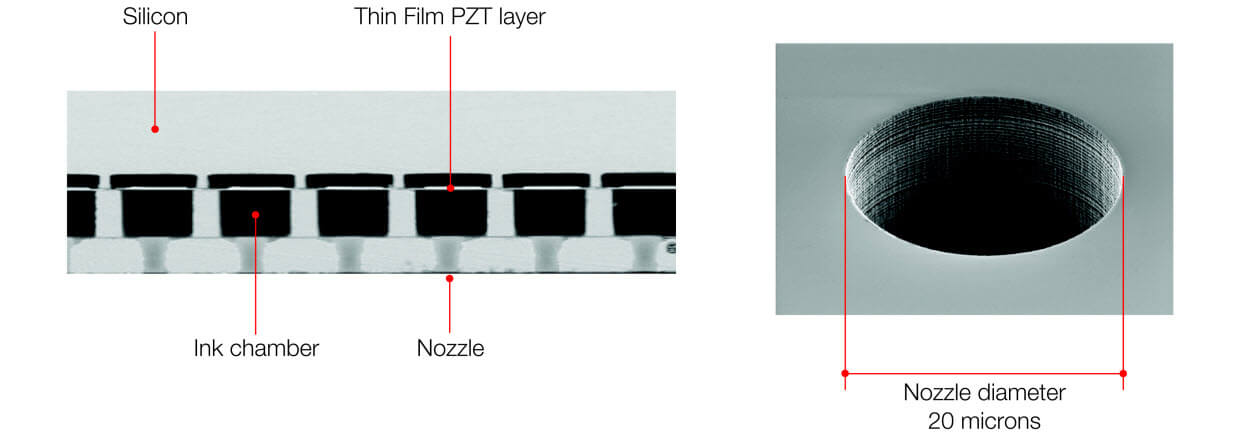
The small, accurate structure of Silicon MEMS enables high resolution, small drops and accurate and repeatable drop placement. These smaller structures are also able to operate at higher frequency than bulk technology.
The result is excellent print quality at truly impressive speeds. Consider the Xaar 5601 print head with 1200 dpi resolution, 3pL native drop size and capable of firing frequencies up to 100 kHz. Figure 2 shows a test image printed on paper – two-point text is just 0.7mm (0.03”) high yet is still readable – although most people will need a magnifier for that.
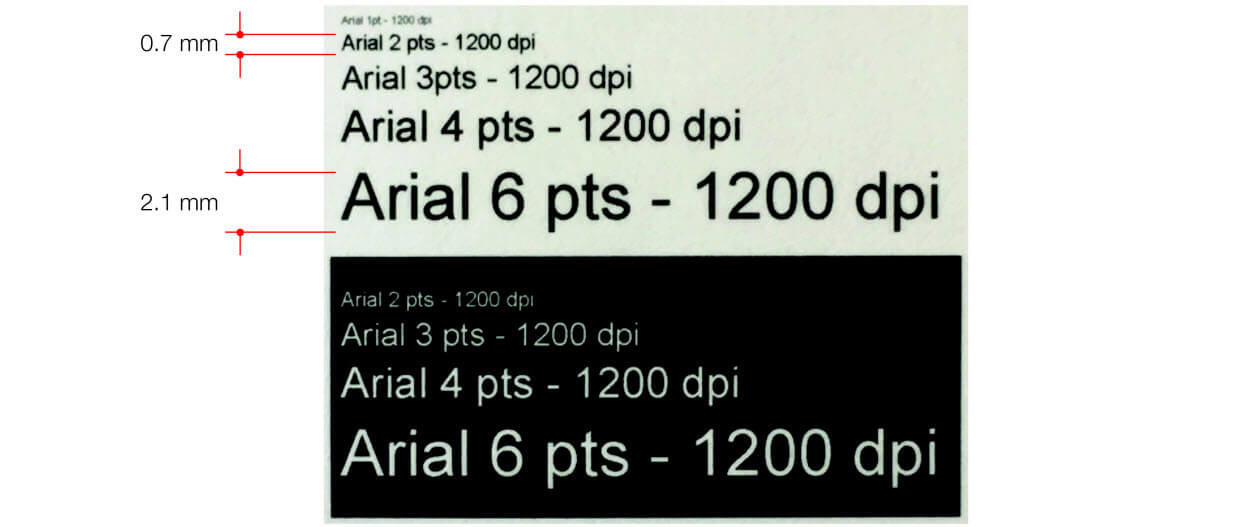
Although such small text is unlikely on textiles, the need for high productivity levels whilst maintaining strong saturated colour certainly is. The Xaar 5601 offers different print modes plus the ability to operate in a single-colour mode or dual-colour mode with each print head supplying two colours, each at 600 dpi. In testing, this has enabled speeds on dye-sublimation transfer paper of over 100 linear metres per minute with the print head in dual colour mode.
Ink recirculation – a must for single-pass productivity
The inner workings of ‘end shooter’ print heads, often used in scanning systems, are relatively simple – the actuator chamber has one ink inlet and a straightforward flow of ink from inlet to nozzle.

nature of the image being printed, or because the print head is idle – the ink can remain for too long in the actuator chambers causing unpredictable changes in its properties, for example temperature and viscosity, which lead to colour differences and reliability issues as the nozzles start firing again. To overcome this, scanning printers incorporate maintenance stations at one or both sides of the machine to allow all nozzles to fire and keep them primed with fresh ink.
One of the challenges previously mentioned for single-pass machines is the fact that, since the substrate is continually moving, there is no down time between passes to do print head maintenance and cleaning.
In an ink recirculation design, the print head has both an ink inlet port and an outlet port and ink constantly flows through the print head to ensure that all actuators have fresh ink even if they are not printing, so they are ready to fire when required without start-up issues.
Ink recirculation also provides higher reliability in challenging industrial environments where debris and fibres are present – dust from ceramic tiles or fibres from textiles. If these particles are of a particular size, they could enter and block the nozzles within a print head.
The first print head to offer ink recirculation was the Xaar 1001, introduced in 2007, which featured Xaar TF Technology, and this still plays a fundamental role in today’s print heads, including the new Xaar 5601.
Recirculation is now an essential feature of single-pass inkjet printing. It transformed the industry when it was first introduced a decade ago, since it allowed single-pass printing to become a production reality.
Xaar TF Technology ink recirculation
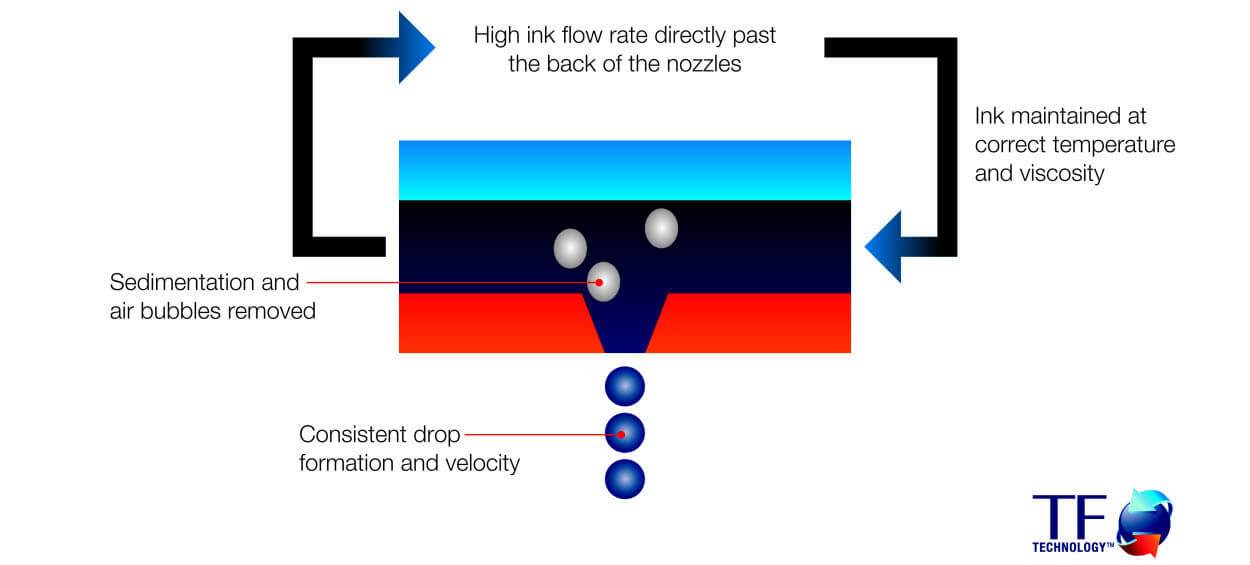
Whilst many print heads now incorporate recirculation, Xaar’s unique TF Technology is characterised by the recirculation being directly behind the nozzles, combined with a high flow rate.
There are two key benefits: firstly, nozzles are always supplied with fresh ink at the correct temperature and viscosity, ensuring consistent drop volume, velocity and formation, for consistent colour reproduction; secondly, sedimentation and air bubbles are removed ensuring high reliability and reduced risk of blocked nozzles due to dried ink.
‘Plug & Print’ print head replacement
Accurate print head alignment is key to ensuring high print quality with inkjet technology, and the more print heads there are in a machine the harder the challenge becomes. Figure 5 shows some examples of print quality defects due to misaligned print heads – stagger, gaps, and colour mismatch.
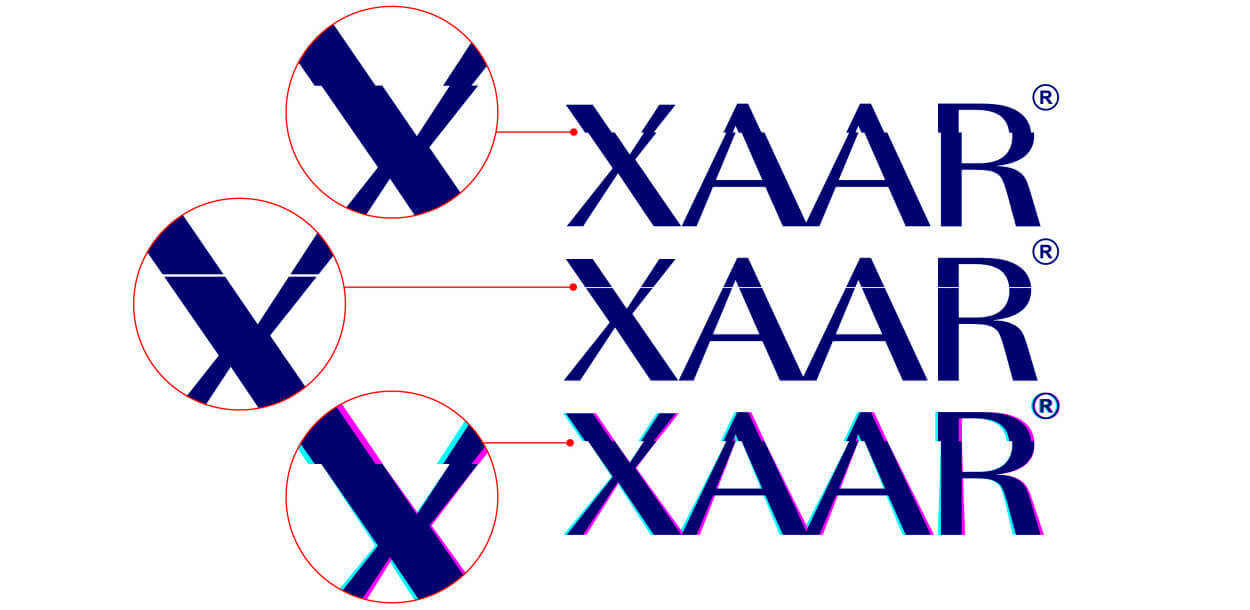
The traditional solution to ensuring correct alignment when a print head is replaced is to call out a qualified service technician to replace the print head and perform the delicate mechanical alignment procedure. However, with single pass machines using many tens of printheads this is no longer viable.
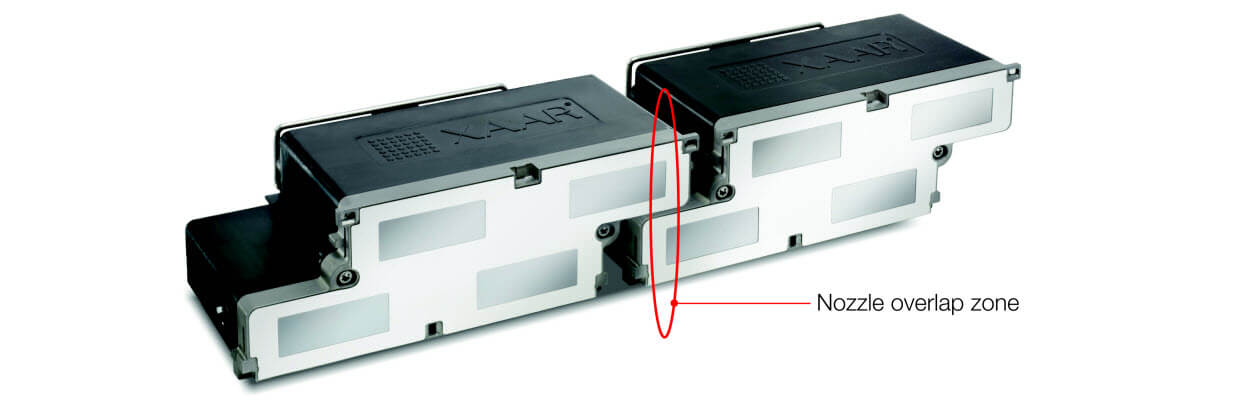
In order to reduce this intervention effort and production downtime, printheads are increasingly offering solutions to this. The Xaar 5601 for example, provides an innovative solution to this challenge. First, the Z-profile allows printheads to fit together with a nozzle overlap zone for ‘stitching’. Secondly, the nozzles within the overlap zone are arranged in a Vernier system, which guarantees that nozzles between neighbouring print heads will be aligned to within one micron.
This makes it possible for software algorithms to be used for alignment as opposed to a skilled and delicate manual process. This brings the ‘Plug and Print’ concept that today is associated with small home printing inkjet devices to the industrial market – print heads can be replaced by machine operators with no mechanical adjustment required and all alignment and calibration is done in the software.
Colour uniformity through individual drop tuning
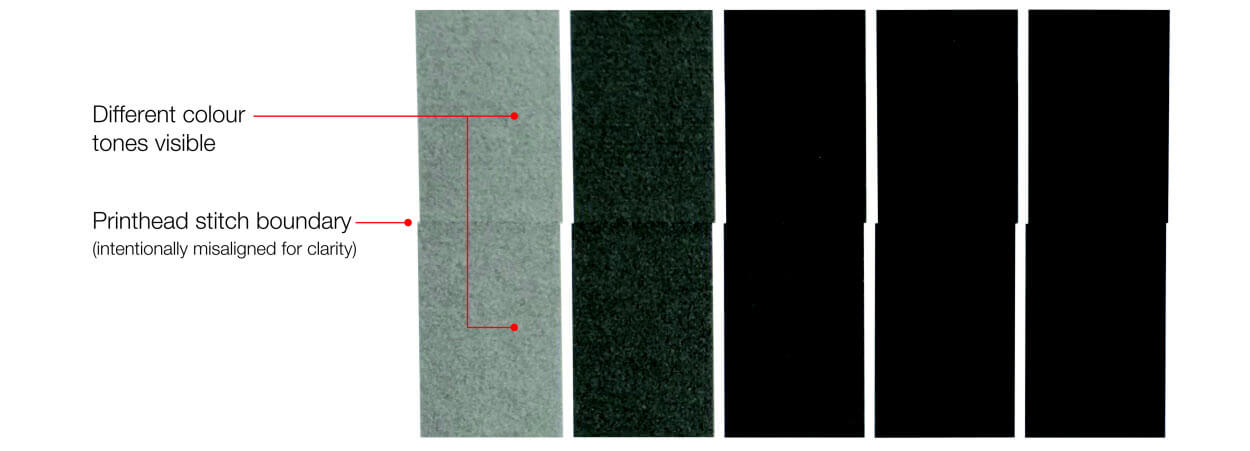
As mentioned previously, scanning machines use multiple print head passes to build up several layers of each colour of ink and to achieve uniform colour, compensating any slight colour differences between print heads. With single-pass machines, there is only one ‘layer’ of ink so any differences between print heads cannot be easily hidden.
Our eyes are extremely effective at noticing colour differences, particularly in pastel colours and greys (see Figure 7). These slight colour differences can be caused by slight differences in drop diameter or drop velocity, which are themselves caused by differences in the ink system or electronics driving different print heads, or slight variations between print heads caused through manufacturing variation.
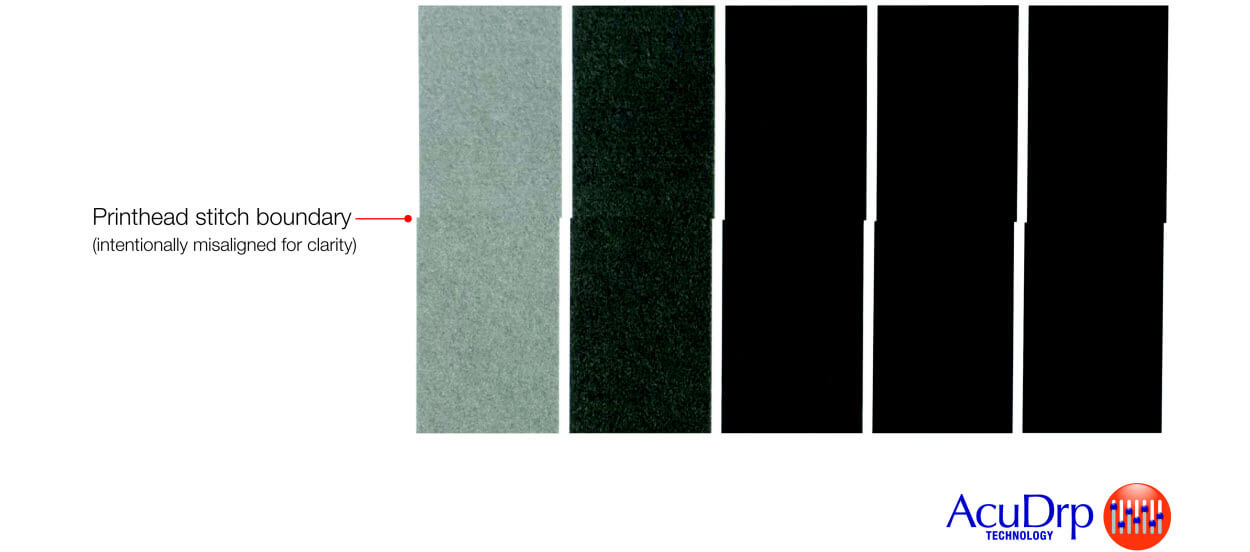
A unique feature of the Xaar 5601, to counter this challenge, is its ability for individual nozzle tuning. Referred to as Xaar AcuDrp Technology, equipment manufacturers can use software feedback and control techniques to manage and precisely adjust the drop size and drop velocity of each nozzle individually. By doing this, banding and colour density variations are minimised and changes in nozzle performance over time can be calibrated and compensated for.
Figure 8 shows the result of a 2% ink density correction being applied using AcuDrp Technology to match the colour density between the two print heads.
Inkjet – the future of textile printing
This article has focused on single-pass technology and how the latest generation of Silicon MEMS piezo print heads, such as the Xaar 5601, are responding to the demands of this new type of machine.
Although single-pass is an exciting new area of growth for inkjet, the vast majority of digital textile machines are and will continue to be multi-pass scanning machines. The Xaar 5601 can also be used for scanning applications up to 1,000 sqm/hr, as can its smaller sister product the Xaar 1201, which is ideal for small to mid-range machines up to 100 sqm/hr.
Textile printing enabled by the latest inkjet print heads not only offers the quality and speed that are comparable with analogue technologies, it also offers a number of unique opportunities. From quick reaction times and the potential to produce large volumes in a very short period without the need to hold stock, through to incorporating style changes with no limitations in colours and complexity of design, the changes are now becoming apparent.
Clearly new business models are appearing in the textile sector and inkjet print heads with their latest features and technologies are integral to delivering this for the benefit of brands, designers, manufacturers, retailers and of course us as consumers.