Formula One racing car drivers can survive a temperature of 840°C for more than 10 seconds, thanks to the performance of their protective suits – long enough, it may be hoped, to escape a conflagration in the event of an accident.
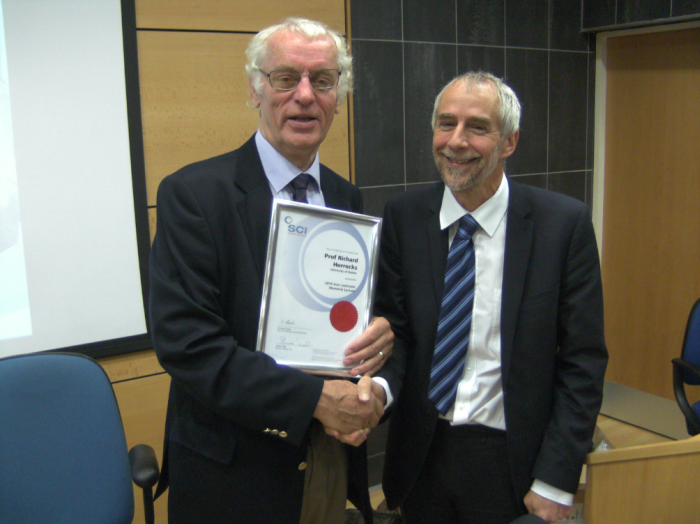 Professor Richard Horrocks (left) receives a commemorative certificate from Dr Trevor Rhodes
This was just one of the impressive facts to emerge from the prestigious 15th Ivan Levinstein Memorial Lecture, organised by the Liverpool & North West Group of the Society of Chemical Industry (SCI) and supported by the University of Bolton, the Textile Institute and the Society of Dyers and Colourists.
The lecture was delivered by Professor Richard Horrocks (Research Professor, Institute for Materials Research and Innovation, University of Bolton and SCI Fire & Materials Group Chair) who discussed many aspects of the role of technical textiles in fire protection.
Earlier, Karen Hobbs (SCI membership manager) introduced the SCI and was followed by Bill Webster (assistant vice chancellor [development], University of Bolton), who welcomed the many delegates.
Professor Horrocks, introduced by Dr Trevor Rhodes (SCI Liverpool & North West Group Chair and Harman Technology), said the development of cotton textiles, engineering/machinery manufacture, chemical manufacture and transport had depended upon many types of industrial textiles, eg ropes, strappings/webbings, drive belts, filter fabrics, packaging such as sack cloths and industrial clothing. During the 1970s to the 1990s the textile industry had moved into Asia, with China becoming the major player. From the 1990s onwards the expansion in the technical textile industry had been dramatic. The technical textile industry in the North West of England was one of the largest in the world and worth some £1.5bn per year.
In most manufacturing supply chains, technical textiles are present in sectors such as construction and PPE (personal protective equipment), as well as in the chemical, automotive, aerospace, marine and rail industries. Because of Fire Safety Regulations and/or legislation in many sectors, fire and heat resistant properties are required in the technical textiles used, especially in contract/domestic furnishings, protective clothing and transportation systems. In the terrorist attacks of 9/11, the World Trade Center buildings had collapsed through the textile-fuelled fires that had generated heat fluxes of >100 kWm-2.
Professor Horrocks pointed out that the flammability of textiles and the fire loads were determined by various parameters such as:
• Ease of ignition
• Rate of burning
• Energy (Heat) release rate
• Production of a protective layer (char)
• Toxicity of fire gases
• Smoke evolution
Fibre and polymer combustion in the presence of oxygen lead to the production of flammable volatiles and gases, non-flammable gases and char formation. A major approach to fire retardancy in technical textiles was to incorporate fire retardants that promoted the production of char. This decreased the production of flammable volatiles and gases. Both Proban-treated cotton fabric and Nomex fabric charred when subjected to a 10-second ignition in the BS5438 flammability test.
Many types of textile fibres had been developed that could impart fire and heat protection to technical textiles. Some typical fibres included:
• Proban-treated cotton
• Pyrovatex-treated cotton
• Lenzing FR
• Nomex III aramid (blend of Nomex and Kevlar 29 [95:5 by weight])
• Kevlar para aramid
• Teijinconex meta aramid
• PBI (polybenzimidazole)
• Basofil novoloid fibre
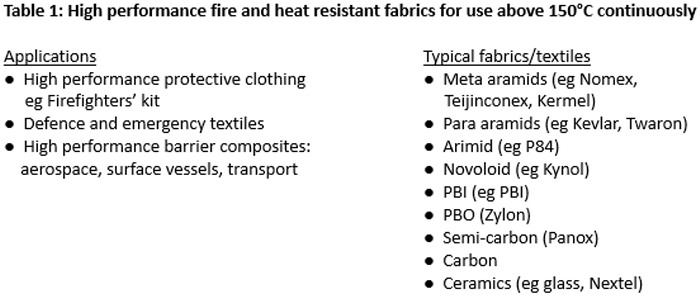
The use of high performance fire and heat resistant fabrics and some typical application areas are illustrated in Table 1 (below):
The introduction of the UK Health & Safety at Work Act 1974 and the European Union PPE Directive 1989 stimulated the markets for protective clothing. Protective workwear and corporate wear for industrial applications such as welding/molten metal, off-shore, wildfire fighting and defence had grown to be a significant market. Such protective clothing had to be worn during the whole working period and needed to be comfortable to wear, relatively lightweight and durable to multiple laundering cycles. Garments made from Proban-treated cotton were durable to over 200 laundering cycles, giving global compliance for flame-retardant workwear that provided protection against heat, flame and electric arc treatments.
Over the last century the evolution of Emergency Services' clothing systems for fire fighters, police and air ambulance workers had led to improved protection. Protective clothing fire performance could be assessed using an instrumented manikin test (eg DuPont Thermoman). BS ISO 13506:2008 subjected the clothing to a flame source of 84 kWm-2, and recorded the torso areas that experienced first, second and third degree burns. Reduction of heat stress was extremely important and was achieved via moisture and heat transfer. Using a Nomex face and Kevlar back, under which was a moisture barrier and a liner fabric next to the skin, the open outer shell layer of the garment optimised breathability and decreased heat stress during firefighting.
For Formula One racing car drivers and other motor sports, the protective suit could consist of 2-4 layers, providing both heat and fire resistance. Drivers in a Nomex fibre overall could survive for 11 seconds in a temperature of 840°C.
In modern jet airliners the jet engines were thermally insulated from the rest of the aircraft using Nextel Ceramic Textiles (3M) that internally surrounded the outer casing of the jet engine. Composites were now widely used for the main structural components of the aircraft, such as internal walls, bulkheads, floors and seats. The Airbus 380 used a 25% carbon-composite airframe for lightness, which improved the aircraft capacity and the fuel efficiency. The Boeing Dreamliner airframe was around 50% carbon composite.
Aircraft seatings and interior décor had to be tested, according to Federal Aviation Regulation FAR 25.853(c) in which they were subjected to a heat flux of 120kWm-2 for two minutes. All internal panels, including external décor (walls, flooring and ceilings etc) had to pass the Ohio State University OSU 65/65 heat release test in FAR 25.853 Part IV, App F Walls, ceilings and floors were reinforced with woven or knitted fabric “honeycomb” panels which utilised glass fibre/phenolic or aramid fibres/polyimide resin. In the OSU calorimeter test, a vertical specimen (150 x 150mm) is subjected to a heat flux of 35kWm-2 with gas flame ignition of the volatiles. In this test both the maximum heat release rate and the heat release rate over two minutes must each be ≤ 65kWm-2.
For aircraft body acoustic and fire insulation, typically a fibrous structure-bag composite is used between the outer skin and inner panels. An experimental bag was developed at Bolton a few years ago, and was tested, according to FAR 25.856(b) Appendix F, Part VII, in which the assembly was subjected to a burner heat flux of 180kWm-2, the calorimeter output then having to be < 23kWm-2 in less than 240 seconds, thereby passing the test.
In commercial, naval and pleasure ships, the hulls, bulkheads and superstructures consisted of fibre-reinforced composites with the flame resistance requirements defined by the International Maritime Organisation (IMO). Internal structures/furnishings required defined levels of flame retardancy. The hazard level increased with the number of passengers in large cruise liners such as the Queen Mary 2 and Mariner of the Seas.
The aerospace innovations had been taken up by modern railway authorities in their composite rolling stock structures, seats, furnishings, and barrier and insulation fabrics. Technical textiles were incorporated in Virgin's Pendolino UK train sets as composite body parts, insulation, seating and floorcoverings.
In cars textile composites were used in the engine compartment, interior head liners and trim, interior floor, trunk, and under floor of the vehicle. All interior textiles had to pass a basic US flammability test, FMVSS302, which is now recognised and used internationally. Polyester was used typically as seating fabric with polypropylene or polyester used for car carpets, and polyester for roof-liners. Floor composites may consist of polypropylene or polyamide 6 surface tufts on a polypropylene scrim with low density polyethylene (LDPE) resin-bonded to the underlying fibrous acoustic layer.
After a lively question and answer session, Professor Horrocks was thanked by Dr Trevor Rhodes for his stimulating and informative presentation. On behalf of the Society of Chemical Industry, Dr Trevor Rhodes presented Professor Horrocks with a framed memento of the occasion.
Have your say. Tweet and follow @WTiNcomment