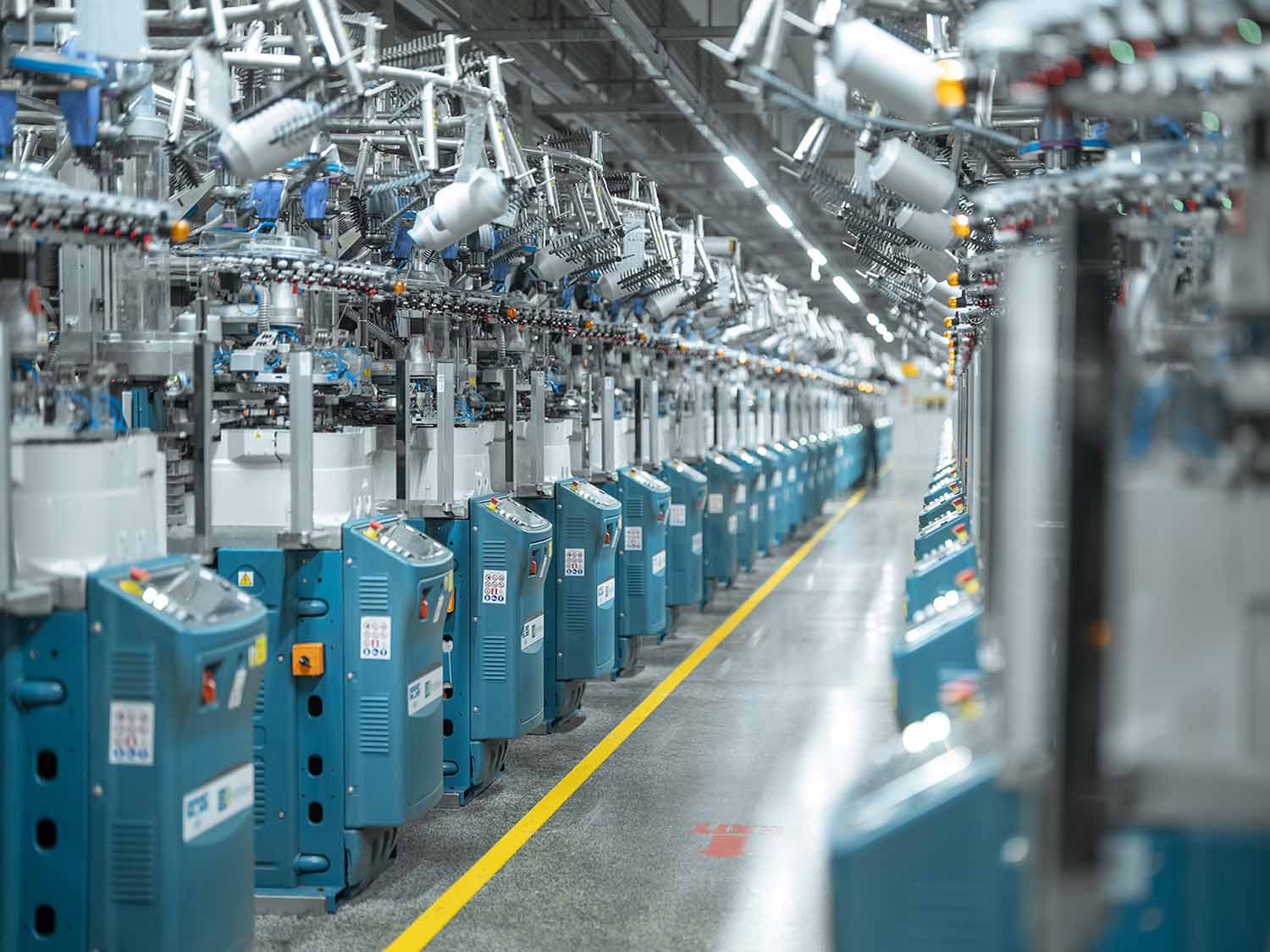
North East Knitting was founded in 1986 after a group of partners refused to let the industry in Pawtucket, US, die. Now, the family-run company specialises in elastics and webbing and serves a variety of markets. John McCurry reports.
Pawtucket, Rhode Island, US, home to the historic Slater’s Mill, the first water-powered spinning mill in the country, is known as the birthplace of the US textile industry. Once a thriving textile centre, there are just a handful of companies left in the city, but one of them happens to be a successful manufacturer with an inspirational story behind its founding.
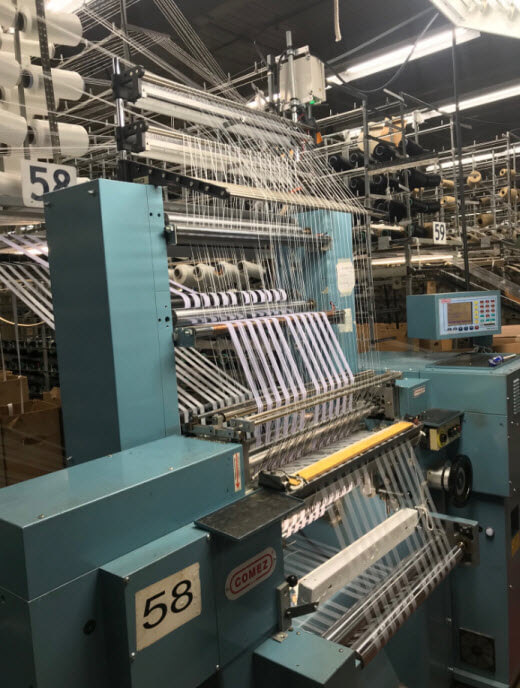
North East Knitting (NEK) is a narrow fabrics manufacturer specialising
in elastics and webbing
North East Knitting (NEK), a narrow fabrics manufacturer, specialising in elastics and webbing, serves a variety of markets, including apparel, safety, sporting goods, medical and automotives. Its founding is a story of hard work, perseverance, determination, and a testament to the critical role immigrants have played in the success of US manufacturing.
Rosalie DaRosa, a native of the Cape Verde Islands, was among several founders of the company in 1986. She came to Pawtucket with her father when she was 18. Speaking very little English, she began working with her father at a company called International Stretch, a producer of elastic textiles. She recalls falling asleep many nights with a radio next to her ear, so she could improve her English. At International Stretch, she was an eager learner, mastering both braiding and knitting machines, and learning all she could about the business.
In the mid-1980s, the company ran into some financial difficulties and eventually declared bankruptcy. Having worked hard to learn the industry, Rosalie DaRosa didn’t want to see her efforts be in vain. So, she and a group of partners bought some of her former company’s machines at auction, leased space in the same building, and thus North East Knitting was born in 1986.
North East Knitting has grown with its customers. About 15 years ago, following a downturn in business, the company added weaving to its capabilities, allowing it to broaden its customer base. Offering braiding, knitting and weaving services, the company became a one-shop stop for its customers. During this period of growth, Rosalie’s three sons – Eric, Michael and Alex – joined the company and now manage its operations.
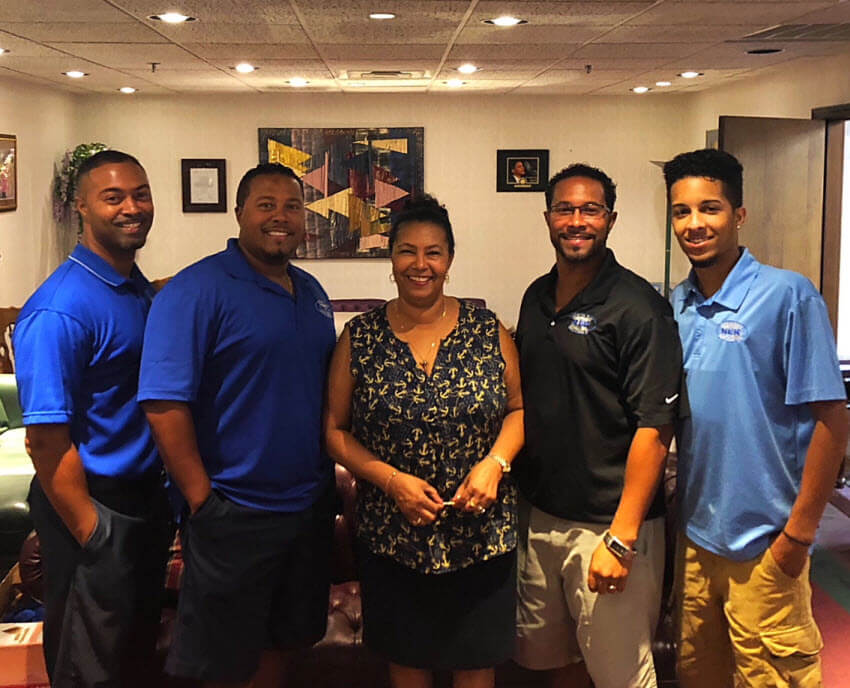
The DaRosa family
“I’ve always liked textiles,” she says. “I’ve been here for 50 years and I was very fortunate to have three young boys. They got a great education and went to work for other companies until I told them I needed them. They go to trade shows and see what demand is there and what markets to try to get into. They have taken this company to another level. What I do is support them and make sure the factory runs smoothly and we hire the right people. That’s the role I play now.”
Eric DaRosa, 42, the oldest of her three sons, says NEK is benefitting from the gradual movement of some segments of apparel manufacturing back to the US.
“There is a niche in custom-made apparel that uses a lot of devices to monitor things such as heart rate,” DaRosa says. “It’s textiles with technology and we are seeing a lot of growth in that area.”
Military is one of the company’s largest markets with NEK’s products going into end uses such as body armour. Industrial end uses include reflective safety vests.
DaRosa says he sees some opportunities for growth, but the company continually seeks to cut costs and deal with government regulations. He notes the movement by the state of Rhode Island to raise the minimum wage.
One of the company’s strategies is to occasionally work with a handful of US competitors to prevent business from going to foreign competitors.
“We don’t call them competitors anymore,” says DaRosa. “We work together because there are only a few of us left.”
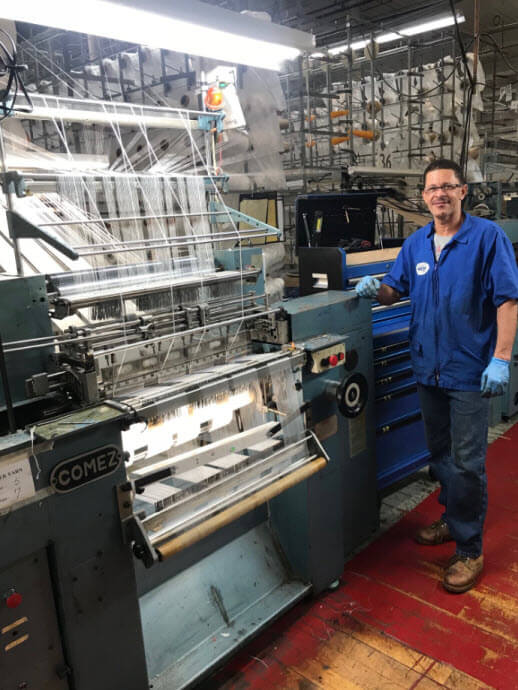
The installation of high-efficiency machines allows operators to oversee more
than one machine
NEK currently employs about 125 on two shifts, sometimes three, depending on demand. As has been the case throughout its history, the company has employed many immigrants to the US, primarily from the Cape Verde Islands, Portugal, Colombia and the Dominican Republic.
The company’s biggest challenge is finding enough labour and enticing young people to enter the textile industry. It is particularly difficult to find skilled mechanics to keep machinery in proper working order. This will become even more critical over the next decade as many of the company’s long-time employees retire.
“We’re looking for a new wave of talent, but for now we go out and set up the machines ourselves,” DaRosa says.
Technology has helped mitigate the labour issue to a degree. Installation of high-efficiency machines allows operators to oversee more than one machine. As part of a long-range solution, NEK and other textile firms in the region have been working with community colleges to try to develop a training programme for mechanics.
NEK has a lot of large-run programmes, but Eric DaRosa notes that the company is willing to do short runs for small companies. It maintains more than 500 different styles.
NEK occupies about half of a 400,000 sq ft, four-storey factory built in 1917. So, there is room for expansion if business warrants it. DaRosa believes there is potential for market expansion in certain areas. While the company does serve the automotive sector to a small degree, he says he would like to become more involved. Aviation is another possibility. While knitting is the primary production process, about 30% of the company’s output is woven. Product development is often a result of collaboration with customers.
“If a customer has an idea, we ask for a sample of the item, or something similar. If we can reproduce it, we give them a quote and a minimum. If they are flexible, we can also offer something in our product line that might work.”
Like many US manufacturers, NEK is finding that there is an advantage to manufacturing at home. Many of their customers have turned to North East after being dissatisfied with China-based suppliers.
Rosalie DaRosa says her textile journey has been her passion, and she believes being passionate about your work is key to achieving success. Her advice is to continually create new products, satisfy your customers and treat your employees well.
“Brag about what you do, but keep improving,” she says. “Don’t be greedy and take everything you make, and watch your company grow.”