The digital textile microfactory is a success; this is beyond doubt. Across the textile and apparel industry, thousands of small successful enterprises demonstrate this on a daily basis, as indeed do the scores of larger textile companies that have successfully adopted the microfactory model in addition to their larger mass-manufacturing projects. And, these companies bear witness to the flexibility and scalability of the microfactory.

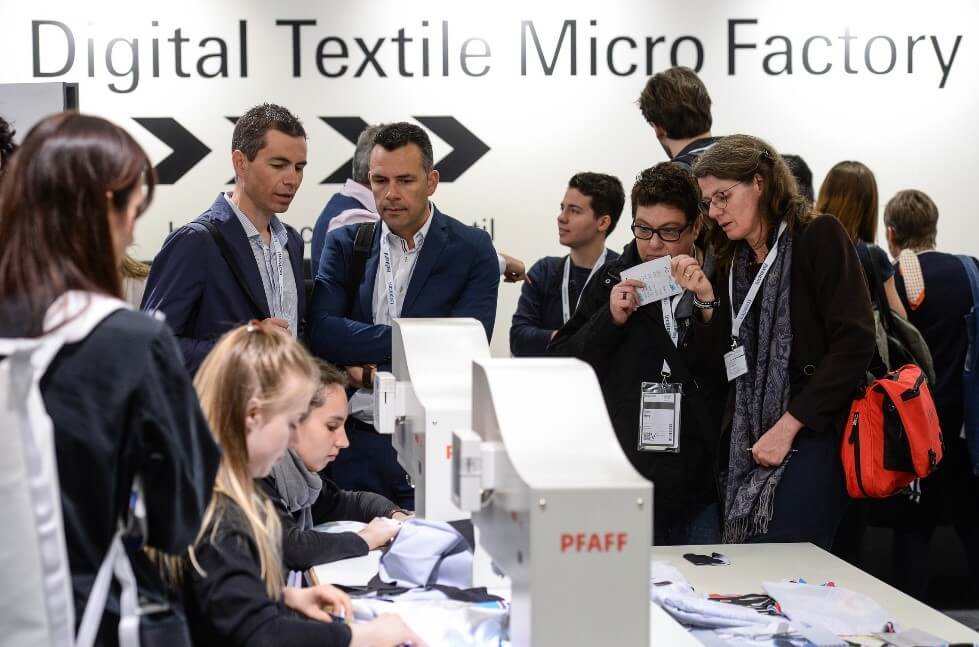
The Digital Textile Micro Factory at Techtextil drew a great deal of interest in 2018. Photograph: Messe Frankfurt GmbH /Petro Sutera
The history of the microfactory
The ‘microfactory’ is considered to have been first conceived in Japan in the early 1990s, harking back to the finest traditions of localised skilled manufacturing, where quality, ingenuity and reputation were the bywords.
The microfactory approach challenges the established model of a large-scale manufacturing plants and workforces. Such traditional manufacturing plants are effective at producing standardised goods at rapid rates, whereby cost is minimised, and success comes from offering a lack of selection to the customer; the economics of this system depends on long-runs of the same product.
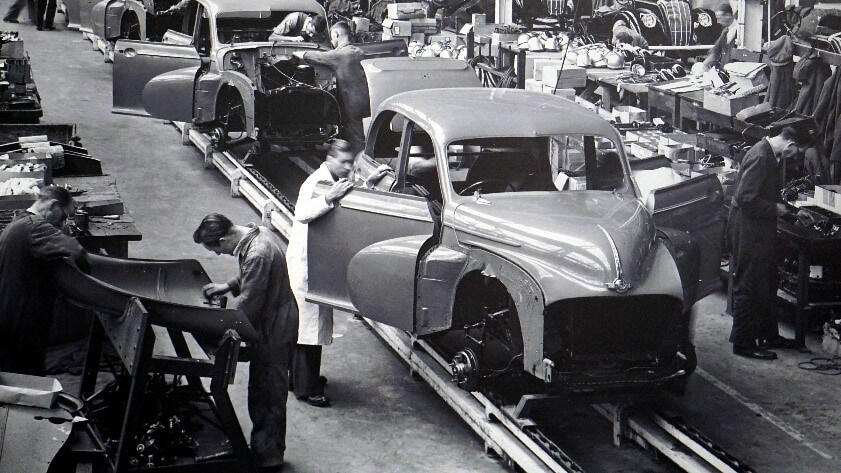
This manufacturing philosophy was coined in the early 1900s – by car-maker Henry Ford with his apocryphal saying that the customer could have, ‘any colour, so long as it’s black’ – and propagated into all industries throughout the 20th century. However, this manufacturing model is rapidly becoming outdated and difficult to maintain, particularly in the textile and apparel space, where brands are looking for shorter runs of more product variants, to meet consumer trends.
Driven by social media and ecommerce, the microfactory is finding its place. Production runs have become shorter and shorter, and salesmen have had to offer more options to close sales.
In essence, a microfactory is any end-to-end solution encompassing an entire product line. In most cases, the microfactory is able to quickly produce customised or personalised products in small-scale production runs, at economical prices.
The onset of Digital Direct Manufacturing (DDM), directly going from CAD to a final product, as well developments in software and machinery to accomplish this, have embedded the microfactory firmly within the Millennial Production Culture.
Existing microfactories have been responsible for not only attractive products but also for original research, product development and design proliferation. In a world where customisation and time-to-market are paramount the, cumbersome large-scale manufacturing facilities cannot meet the needs of the market. The microfactory is therefore here to stay. And, as far as the textile and apparel industry is concerned, the technologies to enable the microfactory are finally coming to the fore, with exponential developments in digital textile printing, web-to-print software and ecommerce applications coming into play. And it means there is an increasingly important role for entry level start-ups to play in the industry, as well as new opportunities for industry leaders to become more flexible and responsive.
Microfactory potential
The microfactory is a small and compact textile business unit that straddles all areas of product creation from design through production and, often, to point-of-sale, in a single cohesive entity. It is a main component in the textile and apparel sector’s move towards Industry 4.0, where the supply chain is integrated, and production monitoring is carried out in real-time and related to product sales rather than forecasts (See Figure 1 and Figure 2 for business model comparison). For this reason, as well as being a production model, the digital microfactory is also a risk-averse financial model, whereby only popular products are delivered, and cash flow precedes manufacturing. Return on Investment (ROI) is therefore high for those investing in the microfactory concept (provided they get it right).
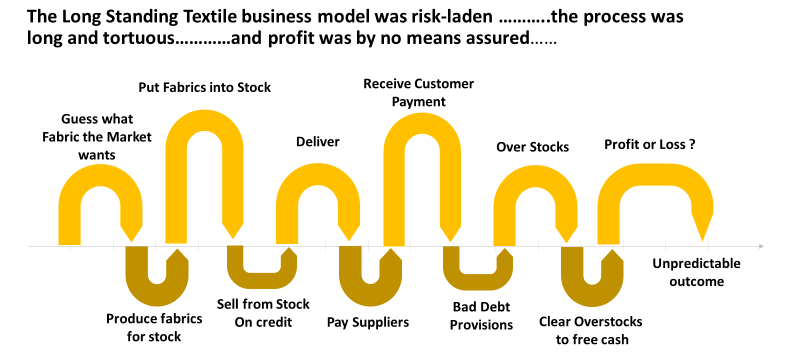
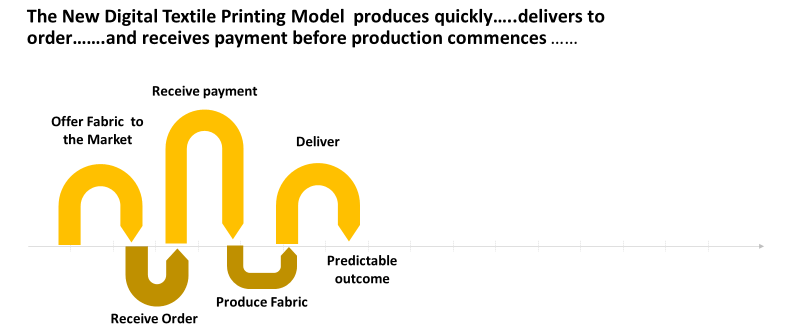
The digital textile microfactory mantra is to ‘sell-produce-deliver’ rather than to ‘produce-sell-deliver’, which is the traditional model. If this former model were widely embraced, there would no longer be a need for large warehouses to hold mountains of stock, produced on speculation that sales will come through. Overstock and closeouts (clearance/discount sales of inventory) wouldn’t be necessary because everything would be produced to order. And thus, financial risk would be virtually eliminated, as payment would be made before production commences, and speculative stock therefore wouldn’t need to be financed, nor credit given to finance customer purchases.
In the microfactory business model, the sale generates the payment, which generates the production order. This workflow is reinforced by sophisticated ecommerce platforms and strategies at the brand end of the value chain.
It is not surprising that the promise of this business model has spawned a proliferation of small, but effective, fabric and garment producing microfactories all over the world. Unquestionably, as far as the textile industry is concerned, this has also been enabled by the betterment of machinery speed, capabilities, reliability, and performance, with inkjet technology playing a major role in microfactory feasibility.
Inkjet’s microfactory role
Since the first inkjet machine for textiles was launched in the late 1990s, production speeds have increased with every year. The original Mimaki TX series of 1997 was capable of printing around one metre an hour, whilst in 2019, its equivalent, the Mimaki TX300P, is capable of between 30 and 60 metres an hour, depending on ink used and the design being printed (among other factors).
As speed has increased, so has reliability and machine performance. Print heads are more robust, pressurised ink circulation systems maintain an even ink pressure and print mark, and with system protection from banding as well as accurate printhead height adjustment, perfect printing of products can be achieved on a continuous basis.
All of this, combined with ongoing reductions in machine prices, has created an environment for the digital textile microfactory to flourish. Yet this is not the entire story, for along with digital print machinery improvements a whole host of software and other technologies provide vital supporting role.
A microfactory can now be established at a modest price, consuming very little capital or resources, but offering a world class service, encompassing not only speedy production and delivery and design to clientele. Small-scale entrepreneurs have recognised the opportunities offered by this sea change and have accepted the challenge gladly. The spread of entry-level textile businesses in all sectors, from fashion to sportswear and interiors has been phenomenal. The dominance of these entry level print enterprises was evidenced in a recent FESPA survey, which stated that 45% of textile print manufacturing businesses now employ less than nine people.
Yet, across the textile industry, what started out as a small-scale enterprise model has shown itself to be scalable, to serve some of the largest players in the industry.
Success stories
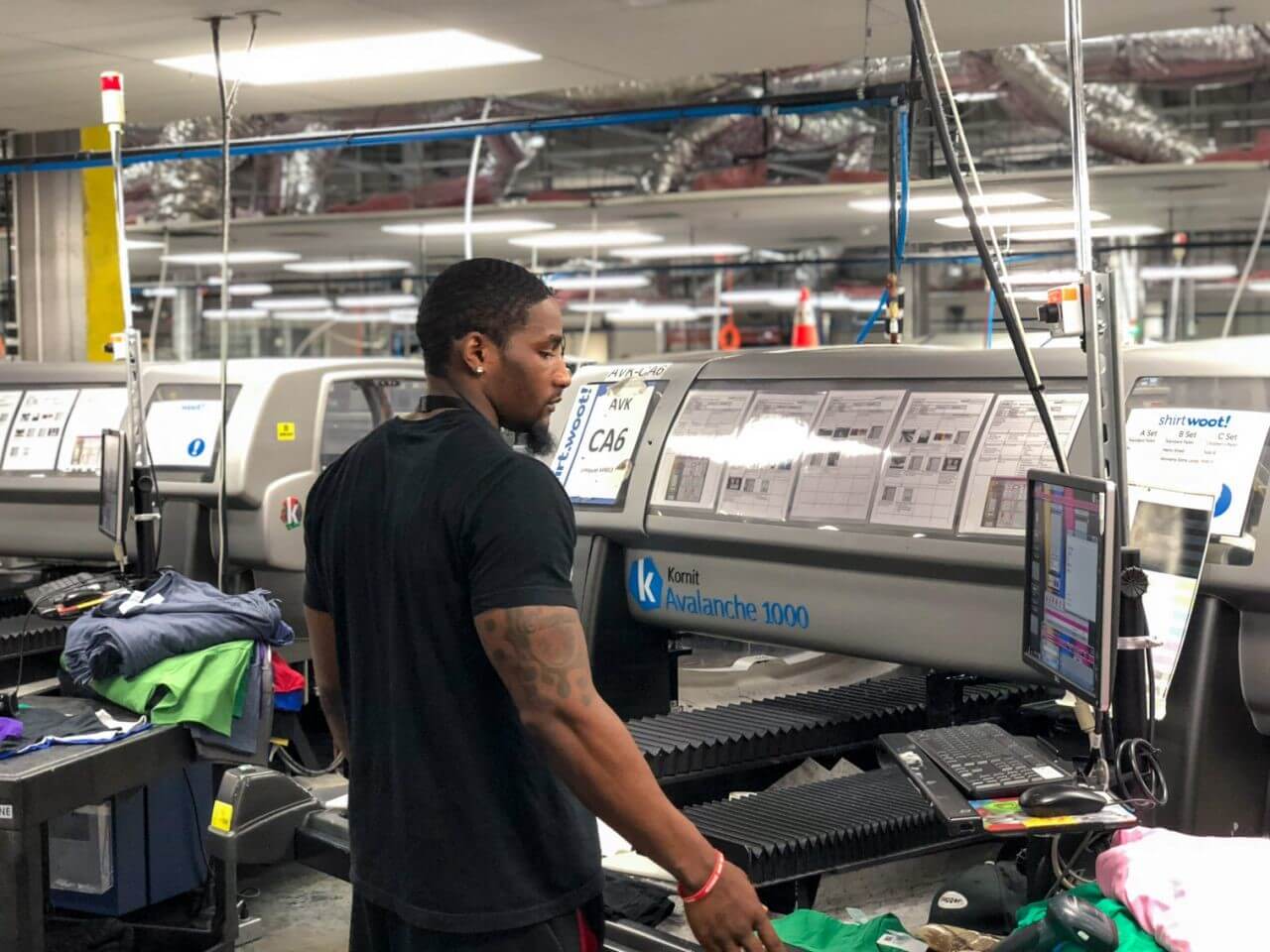
Perhaps the easiest, though most competitive, space to set up a digital textile microfactory in is the DTG sector. The success of the small customised digital T-shirt printing businesses, selling garments printed with personalised designs, is widespread in many countries. It has now led to an upscaled version from Amazon, named Merch by Amazon, where 40 Kornit high-speed DTG printers have been installed in one factory, allowing for a huge range (of over 500 different designs per customer) to be ordered, printed and delivered within a 48-hour window. This digital ‘micro’ factory has been so successful that Amazon is currently seeking official permission to expand the operation to double its current size.
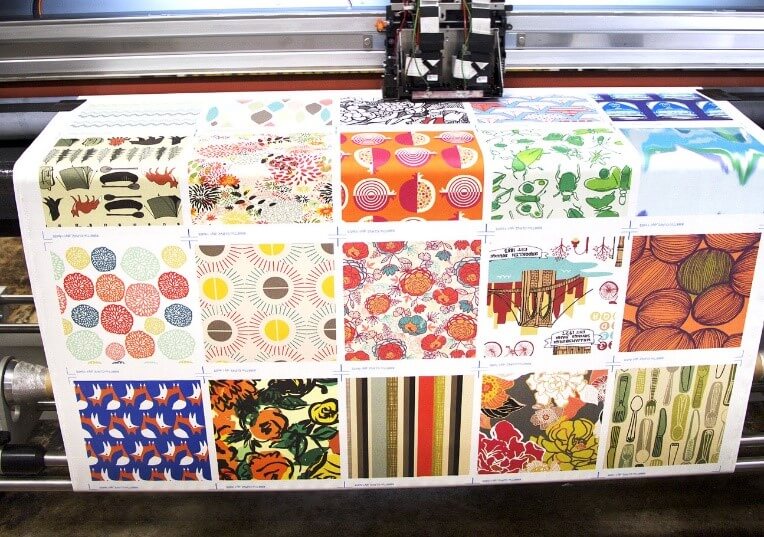
Similarly, the success of now multi-million-dollar business Spoonflower is testament to the potential of the microfactory. Founded in 2008 – and headquartered in North Carolina, US, with a second facility in Berlin, Germany – Spoonflower processes over 4,000 print orders daily. For Spoonflower, this means a large group of textile microfactories operating independently of one another as production cells, but within the same premises.
In this environment, each microfactory team is responsible for contributing to a 48-hour delivery of customised design across a diverse range of fabrics and products, which is the kernel of the company’s success.
Successful across the entire range of printed textile products, with an affordable and scalable model that is being continually strengthened by developments, including laser fabric cutting, single-pass digital printing and robotic sewing, the future for the textile microfactory is enticingly attractive.
Sustainability
However, the story doesn’t end there. For, as the microfactory gains ground in the industry against the traditional business models, so the industry’s consumption of scarce world resources could be encouraged to decline.
The use of digital textile printing in the microfactory model reduces the average consumption of electricity used in the printing process by over 85%. And, where the ink-sets used do not require large volumes of water-based emulsions to stabilise them, virtually no water is consumed (dye-sublimation printing and pigment printing being examples of this. As a result, wastewater is also reduced.
Finally, as the widespread certification of digital ink-sets has established that regulated chemicals – such as APEs (Alkylphenyl Ethoxylate), formaldehyde, CMRs (Carcinogen Mutagen Reproductive Toxins), phthalates and heavy metals – are not present in the ink chemistry, with the additional environmental bonus that many of the inks are bio-degradable as well. All this adds up to an impeccable environmental credential for the digital textile microfactory.