The fifth edition of TheIJC conference, organised jointly by ESMA (European Specialist Printers Manufacturers Association) and Steve Knight from Direct Digital Technologies, once again brought together the global inkjet industry, with 538 delegates in attendance from 26 countries. This was even an increase on the impressive number of attendees at the conference in 2017 and establishes TheIJC as being by far the largest conference in the world devoted solely to ink jet printing technologies.
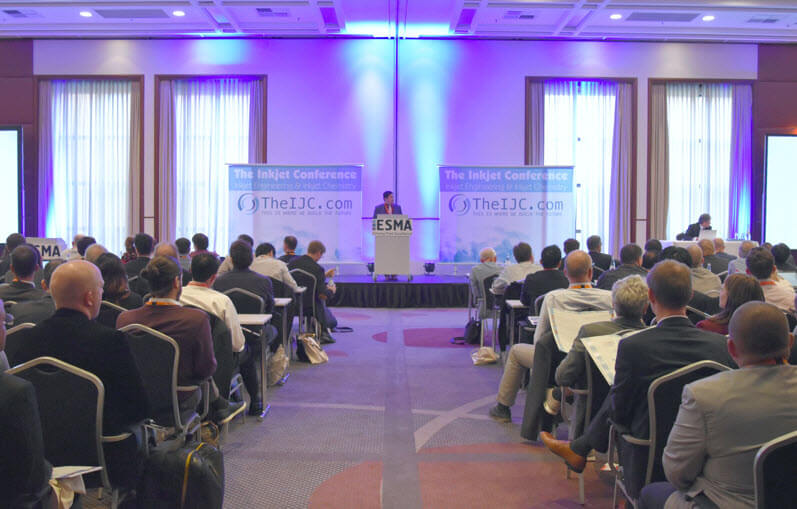
Opening Session of TheIJC in Dusseldorf, presented by Dr Changlong Sun, Ricoh
Held in Dusseldorf on 16-17 October, TheIJC covered the complete range of applications in all industries, bringing in speakers from all sides of the inkjet printing industry, from digital print machinery businesses to printhead manufacturers, software and chemistry providers (of both inks and media surfaces). TheIJC provides an ideal platform to keep up-to-date with developments in the inkjet industry.
This year, the number of lectures totalled 61 and was broken up into plenary sessions on both days – concentrating on printhead technology and new developments – together with three parallel technical tracks over the two days of the conference. An excellent feature of the conference was the table top exhibitions, which this year saw 87 companies and research organisations exhibit, providing the opportunity for networking and further follow up discussions with many of the presenters.
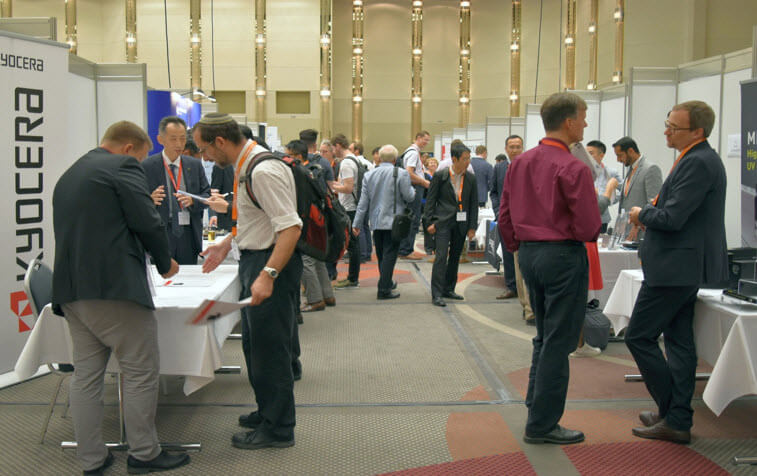
Table Top Exhibitors was a Significant Feature of TheIJC 2018 in Dusseldorf
At this year’s conference there were no specific presentations on digital textile printing, however there were considerable developments shared on printhead technology, ink and media chemistry, which could well have a direct impact on digital textiles in the future. This included new introductions by many of the printhead OEMs, with a focus on nozzle re-circulation technology for dispersion-based inks. Most of the major OEM printhead manufacturers announced developments for their respective printhead architecture. As we will discuss later in the article, the announcements of further developments in printhead nozzle re-circulation technology could have a significant impact on digital textile pigment print market penetration. At the moment the use of digital pigment inks in the roll-to-roll home textile print sector is still small. Current estimates still suggest that digital pigment printing is less than 5% of total digital textile production.
It is well known that many major digital textile print machinery manufacturers are targeting the digital textile pigment area and have introduced ink developments in partnership with textile ink manufacturers. For example, the introduction of the Terra digital textile pigment inks by EFI Reggiani at FESPA Berlin and the recent announcement, at a press conference at ITMA Asia in October, that EFI Reggiani will be showing the Terra textile pigment inks in their single pass machine, the BOLT, at ITMA Barcelona in 2019.
Impactful printhead developments
As there were over 60 presentaions, it is impossible to cover them all in this brief review. I would therefore just like to highlight a number of presentations by the major printhead OEMs and chemical suppliers, that could have an impact digital textile printing, particularly in the home textiles market.
The conference plenary sessions, over the two days, focused on printhead technology developments from many of the major printhead manufacturers, including the major piezo printhead manufacturers Kyocera, Ricoh, Fuji Dimitix, Konica Minolta and Xaar, and together with presentations from Kodak with their Stream and UltraStream continuous printhead technology.
As has been repeatedly highlighted in reviews of digital textile printing technology (1), the key driving force for the on-going market growth of digital textile printing has been developments in printheads, enabling production levels, print quality and operability performance to constantly improve. The printheads used in digital textile printing are all based on piezo drop-on-demand technology and are now used in all new digital textile print machine introductions, both high production scanning and single pass (fixed printhead array) print machines.
Figure 1 gives an update of the global printhead market share in digital textile production, in printed volume terms, based on the latest analysis by WTiN Intelligence: Digital Textiles for 2017. Additionally, Table 1 provides an update on which print heads are integrated into which digital textile printers.
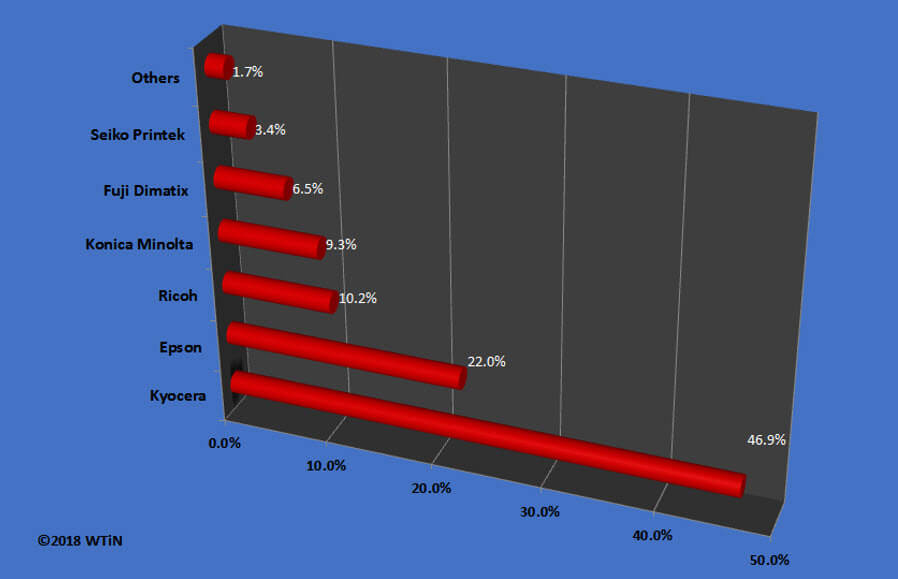
Figure 1: 2017 Printhead market share by total volume of roll-to-roll digital textile print production (2017 production of 2.1 billion sqm)
Source: WTiN Intelligence: Digital Textiles
For the digital textile print industry to continue its expansion, the key is on-going developments in printhead technology. As can be seen from Figure 1, Kyocera still holds the highest market share in the roll-to-roll digital textile printing market by volume of digital textiles printed in square metres. This is due to the wide application of the Kyocera KJ4B series in high speed scanning and single pass digital textile printing applications. The nearest rival is the Epson series of printheads, both the DX types used in many of the small to medium scanning textile print production machines and the ‘precision core printhead’ in the Robustelli Monna Lisa Tre machine line. With the huge increase in production levels in the digital textile printing sector in the last few years, the other major printhead OEM’s are placing much more emphasis on increasing development efforts for the digital textile market, to increase their market share.
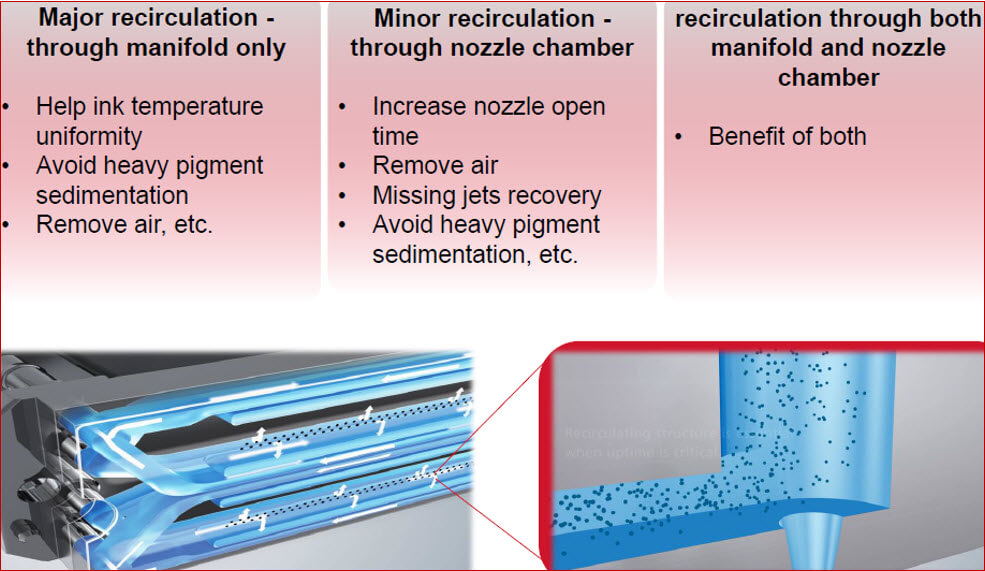
Figure 2: Ricoh MH541F/MF printhead with ink re-circulation technology (Image courtesy of Ricoh)
The major theme of many of the printhead OEM’s presentations at this year’s conference was re-circulating ink technology for pigment-based inks. As each major printhead manufacturer has different printhead architecture, the re-circulation technology obviously varied depending on the specific printhead. In the opening presentation of the conference, Dr Sun of Ricoh gave an interesting overview of the company’s latest re-circulation developments. Ricoh’s MH5421F printhead (3), which uses both manifold ink re-circulation and printhead nozzle plate re-circulation was scrutinised. The addition of nozzle plate re-circulation has a number of additional benefits as outlined in Figure 2, by avoiding pigment sedimentation, removing air and increasing nozzle open times.
Many of the printhead OEM’s presentations in the plenary sessions focused on the benefits of ink re-circulation. In fact, one presenter called the printhead part of the conference, the “nozzle plate re-circulation conference.”
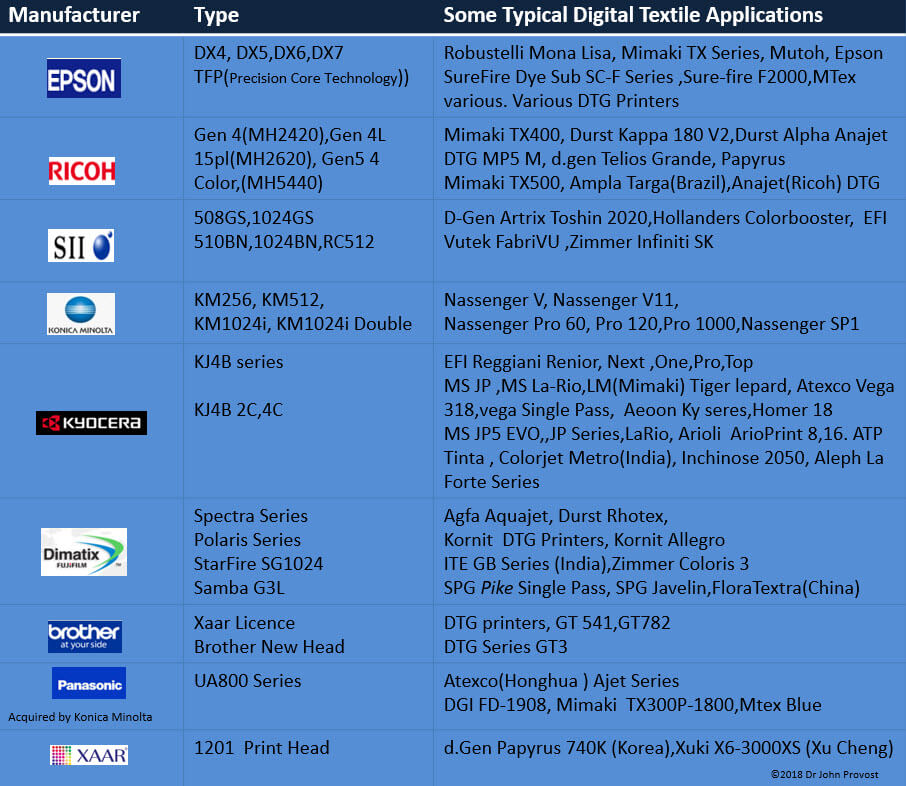
Table 1: Update of printheads used in many of the digital textile printers in the market (all piezo drop-on-demand technology)
Note: Konica Minolta purchased the facility and engineering assets of the industrial ink jet business of Panasonic Precision Devices Ltd (PPRD) in June 2018 (2)
Jason Remnant of Xaar, posed the question: “[Is it] time to stop inkjet evolution and go for inkjet revolution?” Remnant gave examples of inkjet technology revolutions, including ink re-circulation behind the nozzles, to avoid ink sedimentation which improves latency, the ability to fire a drop with increased time between drops. Jason also highlighted the Xaar thin film SiMEMS printhead technology.
Shin Ishikura, Kyocera Fineceramics GmbH, gave a wide ranging presentation, covering the selection of the right printhead for industrial applications, discussing printhead configurations and the selection of the right printhead dpi specification for different industrial applications. Also discussed was the forthcoming launch of the Kyocera KJ4B 0360 (R/C), a 360dpi version of the KJ4B with 1568 nozzles. A case study followed, showing the digital printing of a TiO2 based pigment white ink, using re-circulation technology.
John Corroll of Industrial Ink Jet, the UK technical sales and support company for Konica Minolta and a specialised machine builder/systems integrator, gave a presentation on the new Konica Minolta KM1024aSH, and then discussed in detail the latest re-circulation technology addition to the KM 1024iLHE printhead. This technology will be extended to all the well-established KM1024i series of printheads. The new Konica Minolta re-circulation system is a dual ink flow system at both sides of the nozzle – as shown in Figure 3 – which removes air bubbles and larger particles and achieves stable jetting performance. The dual level ink re-circulation functionality will be added to all KM 1024I series printheads, according to Corrall.
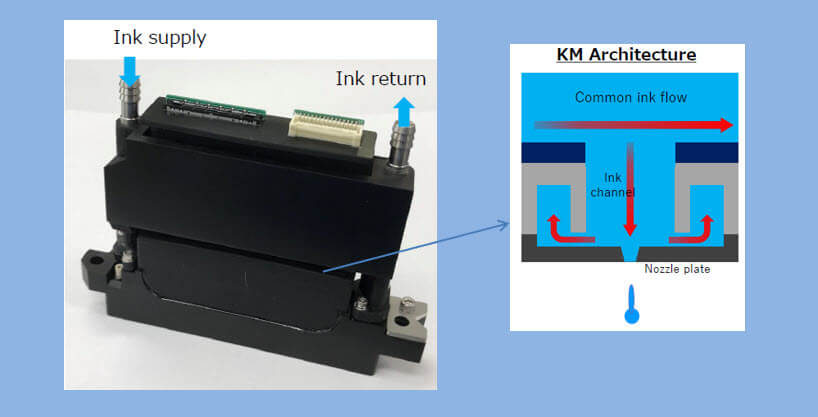
Figure 3: Konica Minolta KMiLHG-25-R printhead with nozzle level dual flow re-circulation (Schematic diagram courtesy of Industrial InkJet Ltd)
Dispersion development
While there were no specific digital textile printing presentations, two presentations discussed the development of stable aqueous pigment dispersions, relevant to produce stable digital textile pigment formulations. Dr Vedran Durasevic of Evonik discussed in detail the challenges associated with development of stable pigment dispersions, with the required properties of low viscosity, long-term storage and small particle size distributions all crucial to ensuring no clogging and optimum jetting performance.
The various stages in developing well-dispersed and stable ink formulations were discussed in detail, with specific dispersing agent recommendations (4). Daisuke Hamada of Kao Chemicals, presented an alternative approach using water-based encapsulated pigments, were the pigment is encapsulated in a polymer structure during the dispersion stage. Although the Kao encapsulated pigments have not been designed for digital textile printing, the use of encapsulated pigments in digital textile printing could lead to less textile polymer binder being required to achieve acceptable wash and crock fastness performance.
There are many approaches to polymer encapsulation of organic pigments (5) and a number of recent digital textile pigment systems, from both European and Japanese ink manufacturers, are making use of encapsulated pigments in digital textile pigment ink formulations (6).
Digital textile pigment printing volumes are still small in the roll-to-roll area, in the region of 3% of the global digital textile roll-to-roll printing market. The increase in the availability of printheads with improved and efficient re-circulation technology from the major printhead OEMs combined with research efforts now focused on both textile pigment formulations and pre-treatment technologies, we will undoubtedly see more reliable digital textile pigment printing systems being introduced at the ITMA Barcelona in June 2019.
The complete set of presentations from TheIJC are available from the organisers and provide an invaluable source of current information on all areas of ink jet printing. TheIJC will return to the Crown Plaza Hotel, Neuss, Düsseldorf, on 29-30 October 2019 and a call for papers and table top booking is now open. For more details, please contact info@theijc.com or ESMA.
References
- J Provost, “Printheads Drive Future Growth”, Digital Textile, Issue 5,2018, pp.22-28
- https://www.nessancleary.co.uk/konica-minolta-buys-panasonic-printhead-business/
- https://industry.ricoh.com/en/industrialinkjet/mh/5421f_5421mf/
- “Dispersing Agents for the Digital revolution in printing Inks” “https://coatings.evonik.com/product/coatings/downloads/coatings%20expert_final_en.pdf
- O Hakeim, A Arafa, L Abdou, “Current Status and Future Outlook Pertaining to Encapsulation of Organic Pigments: Review Article http://www.synchropublisher.com/jms/index.php/wjtet/article/viewFile/27/18
- https://techtextil-texprocess.messefrankfurt.com/content/dam/messefrankfurt-redaktion/techtextil/techtextil-texprocess/hightex-presentations/2/zschinner-schwarz-diamontex-ag-en.pdf
- J Provost, “Pigment Ink Developments for High Production Digital Textiles”, Digital Textile, Issue 2, 2016, pp.10-20