
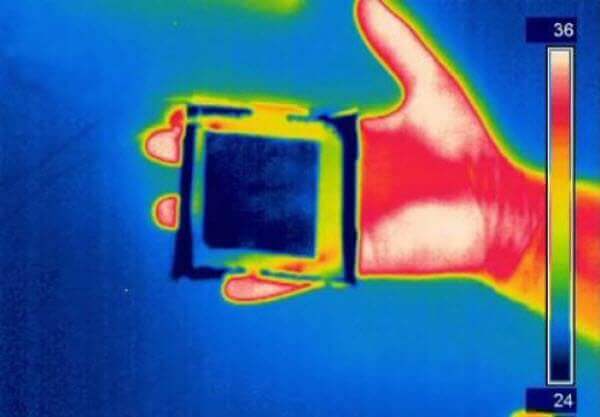
A new type of camouflage makes a human hand invisible to a thermal camera. Image credit American Chemical Society
Hunters put on camouflage clothing to blend in with their surroundings, but thermal camouflage – or the appearance of being the same temperature as the surrounding environment – is much more difficult. Now, a mixed team of researchers from universities in Turkey, the US and UK have developed a material that can outwit thermal imaging cameras.
Most state-of-the-art night-vision devices are based on thermal imaging. Thermal cameras detect infrared radiation emitted by an object, which increases with the object’s temperature. When viewed through a night-vision device, humans and other warm-blooded animals stand out against the cooler background.
Previously, scientists have tried to develop thermal camouflage for various applications, but they have encountered problems such as slow response speed, lack of adaptability to different temperatures and the requirement for rigid materials. Electrochromic materials have been the most promising research effort; these challenges have still been hindering the realisation of adaptive thermal camouflage systems.
The researchers’ new camouflage system contains a top electrode with layers of graphene and a bottom electrode made of a gold coating on heat-resistant nylon. Sandwiched between the electrodes is a membrane soaked with an ionic liquid, which contains positively and negatively-charged ions. When a small voltage is applied, the ions travel into the graphene, reducing the emission of infrared radiation from the camo’s surface.
These active surfaces are flexible, which enables their integration with non-planar surfaces, such as soft robotic systems. Additionally, the system is light (30g/m²) and thin (<50μm).
The team showed that they could thermally camouflage a person’s hand. They could also make the device thermally indistinguishable from its surroundings, in both warmer and cooler environments. The system could lead to new technologies for thermal camouflage and adaptive heat shields for satellites, the researchers say.
Thermal responsive textiles market
Currently, there are four types of thermally responsive materials in use or being developed, according to the Textile Innovation Knowledge Platform.
The four materials are: phase change materials, shape memory materials, thermoelectric materials and thermochromic materials.
There has not been any extensive research into the thermally responsive textiles market, however the global thermochromic materials market size was valued at US$4.77bn in 2016, according to Grand View Research. The increasing demand for innovative products with temperature-based, colour-changing abilities for both entertainment and functional applications has fuelled this growth significantly over the last few years.
The temperature-sensitive materials are being used primarily in the form of inks, coatings, paper sheets and polymers to manufacture practical products, which provide ease of access, entertainment and convenience to customers. Forehead strip thermometers are one such example of printed liquid crystals, which change colour to indicate excessive body temperature during surgery.