It was another tough week for the Australian wool market as prices continued their sharp decline. The loss in the EMI accelerated to 122 cents to finish the week at 1,375 Aus cents a kg clean. The EMI has fallen by 379 cents since sales closed prior to the mid-year break. In US dollar terms, the EMI lost 8.9%, or 90 US cents, to 925 US cents a kg clean. On Wednesday, the EMI plunged 67 cents to 1,430 Aus cents a kg clean and down 51 cents at 964 US cents a kg. On Thursday, the fall in the EMI slowed by 55 cents to 1,375 Aus cents a kg and down 39 cents in US dollar terms to 925 cents a kg.
This week, 26,420 bales were offered, down from the originally rostered figure of 33,046 bales, after 18% was withdrawn prior to sale. Of what was available, 34.9% failed to reach seller reserve. Due to the rapid downturn, exporters were finding it very difficult to trade. Buyer confidence was severely dented by the slipping market. This resulted in the market being unable to find a solid level and prices were consistently reduced as the week progressed.
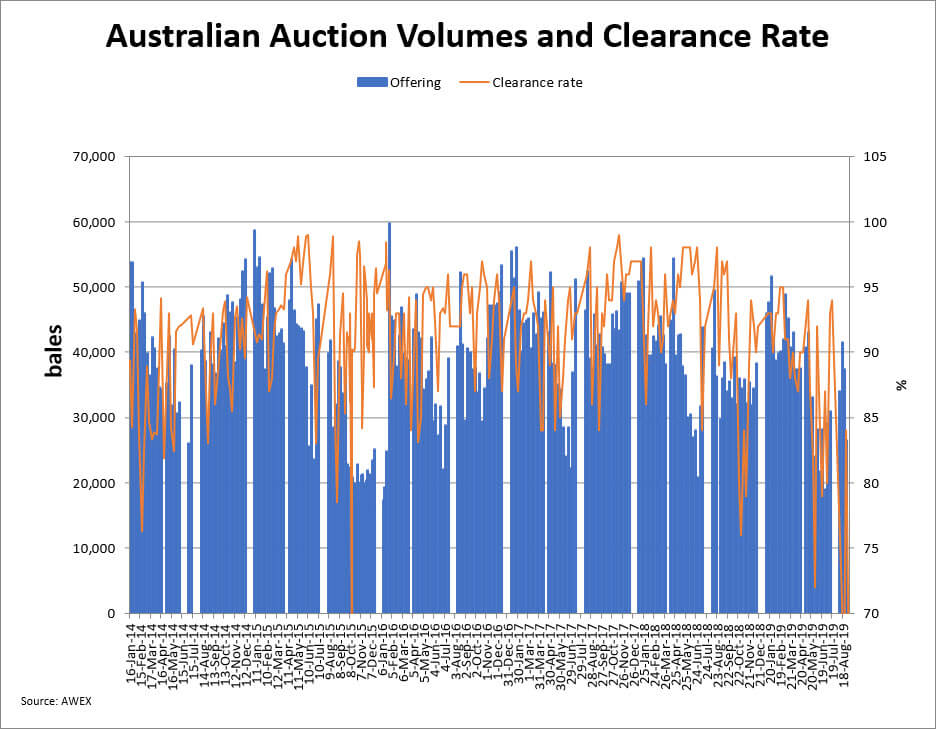
The AWEX reported total value of the wool sold at AUD$26.12m, taking the season total to AUD$267.17m.
In Sydney, prices fell further amid a low clearance rate. All microns lost on Wednesday with 75% of the lots cleared and 20% withdrawn prior to sale. The pattern continued Thursday with further price reductions, a 64% clearance rate and 15% withdrawn. Best style lots with favourable additional measurements and non-mulesed lots were less affected. Best-style, well measured skirtings eased while crossbreds lost on the week. Large reductions were seen among the oddment lots on Wednesday with smaller variable losses on Thursday. The Northern Regional Indicator dropped 116 cents to 1,405 Aus cents a kg clean and the Northern Merino Carding Indicator fell 89 cents to 806 Aus cents a kg clean. The Sydney pass-in rate was 30.9%. The Northern Regional Indicator plunged 116 cents to 1,405 Aus cents a kg clean with an overall clearance rate of 69%, against 86% in the previous week.
In Melbourne, activities followed the same trend with prices dropping on both days of the sale, with very low clearance and withdrawal rates reflecting reluctance among growers to sell at this low level. Non-mulesed lots were keenly sought by buyers on Thursday and tended to maintain their value. The skirtings market followed the same pattern. The crossbred market was relatively stable, a little this week. Sharp price falls were seen in the oddments market. The Southern Regional Indicator fell 121 cents to 1,356 Aus cents a kg clean with a clearance rate of 72%, as against 83% in the previous week.
The Fremantle market recorded the highest losses following the one-week recess. The finer microns were less affected. Nearly 60% of Wednesday’s offering were cleared in with 36.5% withdrawn prior to sale. The respective percentages for Thursday were 50% and 53.5%. The skirting and oddment markets lost ground. The Western Regional Indicator dropped 182 cents to 1,416 Aus cents a kg clean with a clearance rate of 56%.
Reduced demand from Chinese consumers is now being attributed to the price falls, as 75% of the Australian wool clip flows into China for manufacturing. Recent retail data from China has been hard to come by, but since the trade dispute between the US and China began, that data has become scarcer.
Next week, 29,061 bales are rostered for sale across the three selling centres.