
Peru’s camelids, such as alpaca and vicuña, and the communities that farm them are facing a number of challenges due to the effects of climate change – and a range of solutions are being assessed. Francis Rainsford reports.
According to the Intergovernmental Panel on Climate Change (IPCC) Special Report on Emissions Scenarios (SRES), Peru is a country set to be predominantly affected by the effects of climate change. And although Peru is responsible for just 0.1% of global CO2 emissions, it is already one of the countries suffering the most.
Figures from the SRES indicate that Peru will experience the greatest temperature rises in South America due to climate change. The report predicts a dry season average temperature increase of 0.7-1.8°C by 2020, and 1-4°C by 2050.
Additionally, the Stern Review on the Economics of Climate Change – an independent report commissioned by the UK’s Chancellor of the Exchequer – also confirmed Peru is one of the world’s most climate vulnerable countries.
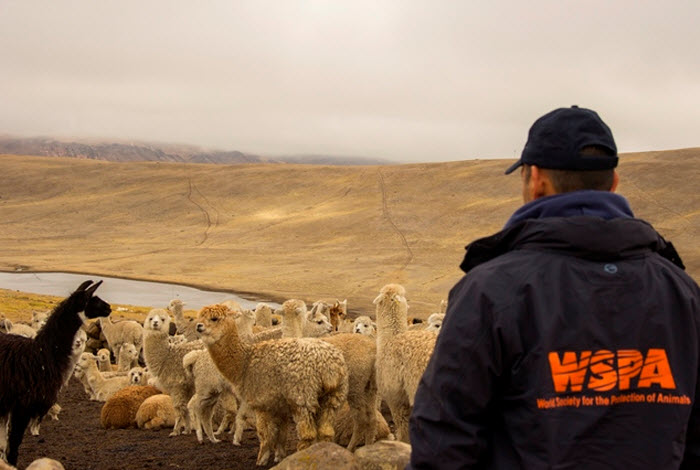 Alpacas and llamas in Peru's Altiplano, surrounded by barren pasture land
More than 99% of the world’s tropical glaciers are in South America, and 71% of these are found in Peru. The glaciers are crucial to Peru’s water supply – particularly in the south of the country – as they slowly release water into rivers that provide drinking water, and water for agriculture, hydroelectricity and industry such as agro-exports and mining.
Studies show that glaciers in Peru have irretrievably lost one third of their surface area since 1970. One of the country’s largest glaciers, the Qori Kalis Glacier located in the Quelccaya Ice Cap, is retreating at a rate of 205 metres per annum.
The unavoidable melting of glaciers in Peru will severely reduce water supplies in a country that is already water poor. In rural areas, agriculture will suffer greatly from water shortages. This will hit the rural poor who rely on small scale farming for their subsistence and will also put local and international export market activities at risk.
Climate change is already affecting rural populations’ access to water and their livelihoods. Farmers in Cusco are reporting irregular rains and intense heat and, since agricultural output depends on rain, farmers will have to adapt their traditional farming practices in areas where rainfall is uncertain.
In the Andean Altiplano region – home to 80% of Peru’s camelid family (vicuña, guanaco, alpaca and llama) – the rains that used to begin in October now begin around mid-December. And while it used to rain throughout most of April, now the rains are over by the end of March. The rains are crucial to maintaining the bofedal (marshland) grazing pastures that the animals depend on for alimentation.
The effects of climate change have reached the poorest and most remote communities in the Andes, which are highly susceptible to adverse weather conditions. And extreme winters are now challenging the Altiplano communities’ ability to survive. They depend almost entirely on alpacas and potatoes for both their livelihood and staple diet, and are struggling to survive through the increasingly harsh winters that coincide with the camelids’ gestation period.
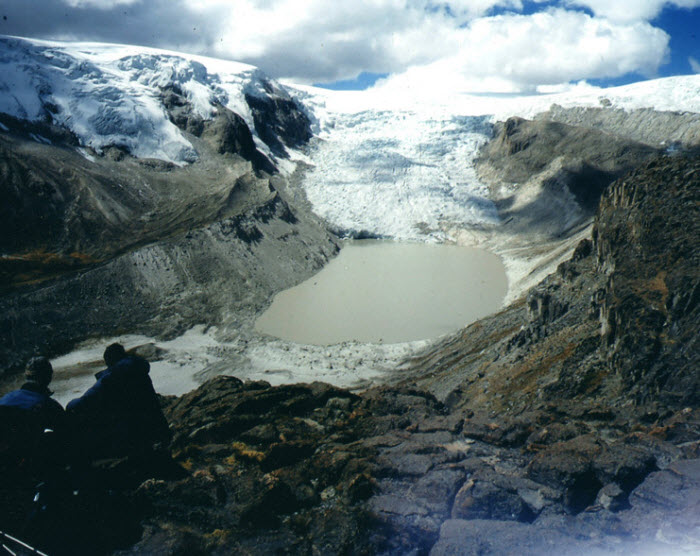 Peru's Qori Kalis Glacier is melting fast
Elizabeth Silvestre, co-ordinator of the Andean Regional Community’s Adaptation to Climate Change Project from 2012 to 2013, is convinced that the only way forward for alpaca and llama farmers in Peru is to understand the evolutionary process of the intensity and frequency of climate events that affect their activity so that planned actions can be implemented or immediate answers given as “adaptation measures”.
She believes the main extreme events affecting the raising of camelids in the high Andes are severe cold, which includes snow and ice, and such events are growing in intensity. At the Alpaca Fiesta conference in Arequipa in 2014, she said: “Recent evaluations in the Arequipa, where changes observed during extreme events related to the raising of camelids, must now be managed in the form of alternative adaption methods from the aspect of climate.”
Other voices in the camelid world are singing a similar tune. Daniel Arestegui, of the Instituto Peruano de la Alpaca y Camelidos (IPAC), says: “Changing our farming methods as a result of the change in climate can bring about improvements in what we do. For example, it has been the custom and practice for alpaca farmers to let their animals roam and feed off the natural grasses, such as ichu, growing in the Altiplano.
“Now that these grasses may start to become scarce as harsh winters and drought affect their ability to grow, it has become necessary to cultivate other grasses, such as alfalfa and avena forrajera, in a combined manner of organising a better management of less available water and a planned seeding strategy to cover a 12-month cycle,” he continues.
“Tests carried out over the past two years have shown that alpacas fed entirely on a cultivated grass programme yield fleece weights of up to 25% more than animals that forage for wild grasses,” adds Arestegui. “If we project forward this change of management, alpaca farmers will be able to produce more fibre and improve their income. Other benefits indicated are that the overall quality of the fibre is improved, as is the health of the animal – thus generating savings on veterinary bills.”
 As natural grasses may start to become scarce in Peru’s Altiplano, it has become necessary to cultivate other grasses, such as avena forrajera (above)
As if a changing climate wasn’t bad enough, Peru has another geographical disadvantage, too. It is a warm country and subject to droughts and extreme weather – which are frequently exacerbated by El Niño phenomena. El Niño is a warming of the ocean current along the Peruvian coast that causes changes in the region’s weather patterns. A major El Niño event generally occurs every three to seven years.
The current El Niño that commenced off Peru’s coast during the latter part of 2015 is showing signs of being far worse in terms of damage than the last devastating one that occurred in 1998, and has begun to cause extensive flooding in the northern tropical regions of Peru and drought conditions in its southern Andean regions.
Specifically, it will mean an added challenge for the country’s alpaca farmers, who have anticipated imminent water shortages with a stockpile of bales of hay accumulated during the past few months as well as sowing extra quantities of avena forrajera (which is renowned for its ability to grow in drought conditions). The country’s largest alpaca producing region, Puno, has put by some 750,000 kg of hay as emergency feedstuff for its animals.
While most nations see the impacts of climate change as a future issue, they are being felt right now in Peru. Discussions at government level are ongoing about how to incorporate climate change into national policies. Solutions are focusing on increasing the capture and storage of rain water during the wet season, and increasing government investment in dams, tunnels and reservoirs.
There is also a campaign to build a tunnel channelling water from the Atlantic side of the Andes, but it will require an investment of at least US$77.5m.
Since 2008, the Peruvian government has identified the possibility of pumping water from the Pacific Ocean and desalinating it but, so far, there are no signs that any such project is ready to commence.
While the government tries to adopt and implement a national strategy to tackle the climate change affecting the country, its communities, which are dependent on the raising of camelids, are left with no other option but to implement “adaptation measures” born of their own initiatives and willingness to change. At this stage, the only certainty is of an uncertain future and that things are unlikely to be the same again for Peru’s camelids.