Cotton futures were mixed in consolidation trading this week, while support came from talks of significant progress in the US-China trade war meetings held in Beijing this week. Reports said that the dispute could be resolved by the March deadline or at least very close to that period. No details were announced about the negotiations and no amounts or time frames for any agricultural product purchases from the US were made public. Meanwhile, Indian crop remains smaller, but the US crop appears big enough to meet all the demand that has been much reduced so far this year. World cotton production and supplies are still lower due to bad weather in growing season for major producers around the world, including India, Pakistan, and Australia. Demand for US cotton was disappointing, as the weekly export sales reports have shown average demand at best since the start of the marketing year. China has not bought any US cotton so far this year and has been active in other markets, especially India. March contracts settled at US cents 72.49 per pound, marginally down from last week, while December was also settled slightly lower at US cents 73.64 per pound.
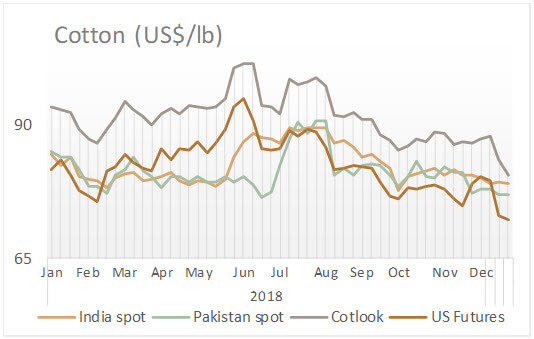
Global spot benchmark, the Cotlook A index, gained US cents 2.75 week-on-week to close at US cents 82.40 per pound.
In China, cotton spot market was stable-to-weak amid a lukewarm sales and wait-and-see sentiment. Suppliers mostly rolled over offers, with Hubei-origin grade-1228 offered at 14.90 Yuan a kg (US cents 100 per pound). Some were in favour of reserved cotton competitively priced rather than new cotton. Most cotton suppliers offered flat, while ginners mostly concluded their operation and shut down for the Lunar New Year break. The China Cotton Index inched up 26 Yuan this week, to close at 15,378 a ton (US cents 103 a pound).
In Pakistan, the revival of buying interest early in the week pushed prices up, as many leading spinners rushed back to replenish stocks helped cotton prices opening the week. Factors including the UAE’s funding for the country’s depleting foreign exchange reserves helped build confidence. Prices remained elevated during the week amid positive developments on local and global fronts. The Karachi Cotton Association spot rate gained PakRs160 its to close the week at PakRs8,860 per maund ex-Karachi.
In India, cotton prices declined in line with the rise in arrivals from the new crop in local markets. Demand was also relatively depressed from domestic spinners while rise of the INR weakened export potential. Exports, which had picked up after a two-month lull due to signs of US-China trade truce, were halted due to consistent higher prices in domestic markets in December, making export economically unviable, trade reports said. Indian cotton is pegged higher or at par with the crop from Australia, West Africa, US and Egypt, which is far superior in quality. Benchmark, Gujarat Shankar-6 was traded this week at INR42,800 per candy (US cents 77.49 per pound), INR600 down from last week.
Cotton yarn
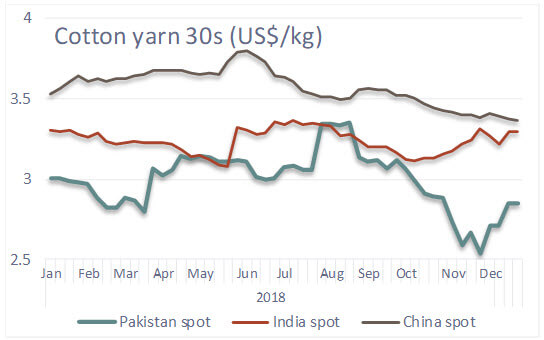
China’s cotton yarn market saw a price drop for some combed yarn varieties and deals mainly done for 32s and 40s yarns. Meanwhile, producers were planning to shut down for the vacation from mid to late January as the yarn markets will remain under weak correction amid poor transaction. Downstream weaving mills will be shut down gradually for the vacation, with the Spring Festival drawing closer, thus the markets will probably enter into a standstill. In Pakistan, cotton yarn prices were seen rising for popular counts both in Karachi and Faisalabad yarn markets. Reportedly, orders received by exhibitors in Heimtextil have emerged as the hope for the slowing textile industry. There are signs of a better offtake of cotton yarn by spinning mills and once the cycle starts moving, the entire cotton chain will be boosted. In India, yarn prices have fallen in the last few weeks over a fresh drop of cotton prices. Export demand was relatively weak after the INR rose further.
In China, 32s cotton yarn prices rolled over at 23 Yuan a kg (US$3.39 a kg), and 40s at 24.10 Yuan a kg (US$3.55 a kg), both up US cents 3-4 due to strong Yuan. Combed yarn prices of 32s were down to 23.50 Yuan a kg (US$3.46 a kg) while 40s sobered to 26.30 Yuan a kg (US$2.87 a kg), both were up US cents 2 due to Yuan. In Pakistan, 30s carded prices in Karachi remained unchanged at PakRs175-180 per pound (US$2.76-2.84 a kg), while 32s cone in Faisalabad gained PakRs2-4 to PakRs188-198 per pound (US$2.96-3.12 a kg, up US cents 6). In India, 30s carded cotton yarn for knitting remained unchanged at INR231 a kg (US$3.28 a kg, down US cents 3 due to weak INR) in Coimbatore, while export offers were flat at US$2.88 a kg.