
It really is a most extraordinary sensation. Wearing a virtual reality headset, you are immersed in a colourful woodland scene. An animated bird hovers into view. You hold out your virtual hand and the bird swoops down and settles on it. You feel its tiny claws inching their way across your palm and onto your fingertips.
Only it’s not your hand at all, of course. The sensation is provided by the UnlimitedHand, a wearable sleeve which simulates the sense of touch within virtual environments and is poised to become an integral part of virtual reality gaming experiences.
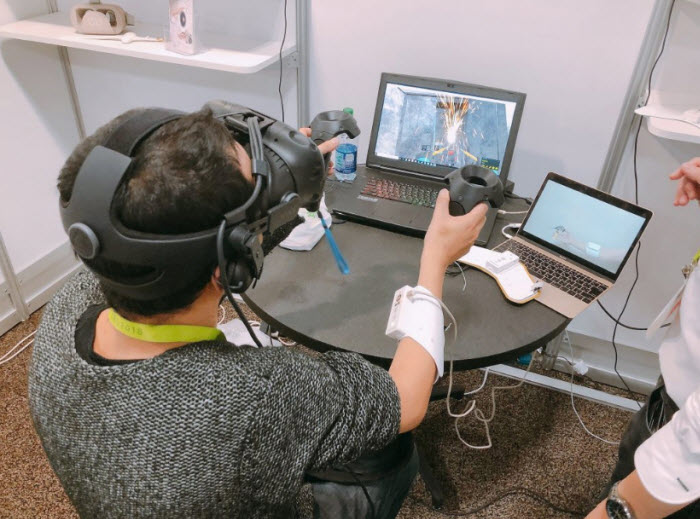 The UnlimitedHand being tested at the 2018 Consumer Electronics Show (CES) in Las Vegas
Motion and stimulation
Its developer, Tokyo-headquartered H2L, working with Nippon Telegraph and Telephone Corporation (NTT), has to date been marketing it as a development tool for game creators.
For input, it is fitted with 3D motion detectors to detect arm posture, along with an array of muscle motion sensors for the fingers. For output, it is equipped with a vibration motor and eight channel electric muscle stimulation (EMS) electrodes for haptic feedback.
“With EMS, the fingers and wrists are moved automatically,” says H2L CEO Ken Iwasaki. “As a consequence, kinaesthetic feeling is generated that in combination with visual content can be used to recreate the sensation of touch.”
H2L initially raised US$75,000 on the crowdfunding site Kickstarter to bring the project to life and the product has consequently been licensed in Asia and the USA. It retailed on amazon.com for US$319.99 during its developmental stage.
Now, however, following a demonstration of the product’s full capabilities at the 2018 Consumer Electronics Show (CES) in Las Vegas, H2L is teaming up with virtual reality theme parks and collaborating with entertainment companies to accelerate its commercialisation.
Knitted sleeve
One important development has been in the advanced textile technology now being employed in the new knitted sleeve for UnlimitedHand.
“The current test model of UnlimitedHand uses hydrogel pads that are commonly found in other EMS products, in order to provide the necessary resistance between human skin and the electrodes,” says Iwasaki. “However, several inconveniences prevented H2L from bringing full satisfaction to our customers. They included uneasiness brought about by the stickiness of the pads, the tendency for the pads to harden as moisture depletes, which lowers the effectiveness of the stimulus, and hygienic concerns due to the difficulties in cleaning the device.”
In order to remedy this, NTT teamed up with Toray Industries in order to develop a variant of Toray’s hitoe fabric as a replacement for the hydrogel pads.
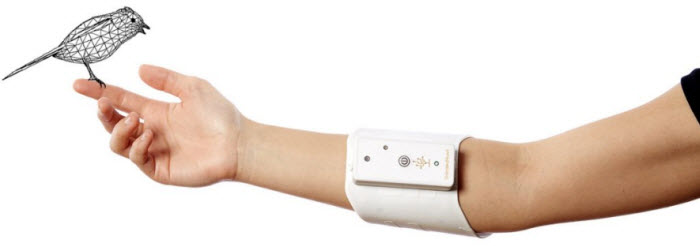 Toray’s Hitoe knitted nanofibre fabric has greatly improved the effectiveness of H2L’s UnlimitedHand
Hitoe is a highly-conductive knitted nanofibre fabric infused with either conductive polymers or polymeric compounds that conduct electricity.
With textiles made of normal polyester fibres, infusing the fabric with conductive polymers leaves large gaps between the fibres, causing the polymers to fall off easily after the fabric is worn or washed, Toray explains.
However, with hitoe, the conductive polymers enter and fix themselves in position within the small gaps left between the nanofibres, and as a consequence stay on the fabric even after many hours of use or repeated washing.
Soft texture
Hitoe’s nanofibre structure provides a very soft texture, and a special coating on the back provides suitable moisture permeability and retention which ensures the fabric doesn’t make the skin feel itchy or irritated, keeping clothing – or in this case, the wearable sleeve – comfortable for long periods of time.
“After implementing hitoe on UnlimitedHand, H2L has managed to solve the problems caused by conventional gel pads,” says Iwasaki. “The product can now be worn repeatedly without losing its effectiveness and can be washed over 100 times. In addition, hitoe has solved the problem of stimulus inconsistency caused by individual differences in skin types when using gel pads – dramatically increasing the performance of haptic feedback. Due to these improvements, we have overcome one of the main obstacles to fully commercialising a product that to date has only been marketed at a niche user group of specialist developers.”
E-Skin
Another product from Japan developed to enhance virtual reality gaming is the ‘e-skin’ shirt from Xenoma, a spin-out from the University of Tokyo.
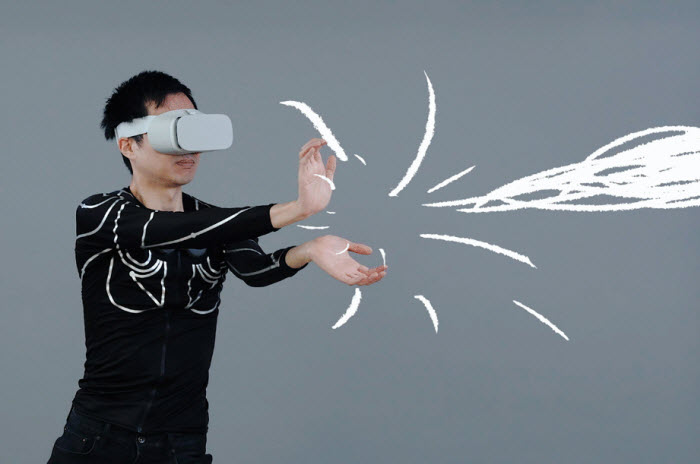 The e-skin shirt incorporates stretchable sensors and electronics that detect the user’s movements
This was also launched on Kickstarter last September, easily reaching its modest US$50,000 target, and the first 100 backers who pledged US$479 received their pre-consumer version e-skin shirts in February.
E-skin knitted compression garments for creating camera-free gesture and motion tracking incorporate stretchable sensors and electronics which detect the user’s movements, while maintaining the comfort, durability and machine washability of regular shirts.
In doing so, says Xenoma, they provide an intuitive and immersive input for interacting with virtual reality content and games, as well as a means for analysing exercise and athletic sports.
Just a shirt
“Connected clothing will be the most natural way for people to interact with others and their smart devices in the future,” says Ichiro Amimori, co-founder and CEO of Xenoma. “E-skin apparel is completely different from other wearable devices in that first and foremost, it’s still just a shirt that anyone can wear. We created it by first focusing on the feel of the shirt so that it maintains the comfort, durability and machine washability of a regular shirt, since we believe this is imperative for it to be fully embraced by all. So, we do not refer to e-skin as a ‘wearable device’ because it is just a shirt, and a shirt is always to be worn.
“We launched on Kickstarter to provide a new, open source medium to the community of passionate developers, designers, artists and musicians to create user experiences to share and learn from. We believe there are a variety of needs where e-skin can provide a solution to satisfy and help people and we want to provide the tools to empower this.”
The e-skin shirt has 14 strain sensors and the e-skin Hub has a sind -axis accelerometer and gyroscope. The hub transmits information to a smartphone, tablet, laptop or PC via Bluetooth and has a Micro USB port for re-charging. The e-skin software development kit (SDK) supports application development and data analysis.
Voltage drop
“The resistance of the strain sensors on the e-skin shirt change when they stretch, and we have developed the algorithm to recognise human movement – arm bending etc. – by measuring the voltage drop in each channel in the e-skin Hub,” says Amimori. “The hub can also detect movements like jumping or stepping through the six-axis accelerometer and gyroscope. A configuration screen is designed in which you can intuitively understand the e-skin status. You can see the state of communication and individual sensor response in it.”
Xenoma’s e-skin and SDK supports application development using Java SDK, Visual C# and Unity, and new features have been added to the software to interface with the Microsoft HoloLens on the Universal Windows Platform (UWP).
Machine learning functionality has also been incorporated through a data and movement visualisation tool that can plug into Google’s TensorFlow – an open-source deep learning library for machine intelligence. Software compatibility to support macOS, iOS and Unreal Engine will also be added in the near future.
Founded in November 2015, Xenoma now has offices in Tokyo, Japan, and Worcester, Massachusetts, USA. It is working with many Japanese apparel companies on the further development of its Printed Circuit Fabric (PCF) technology employing stretchable electronics.
Innovation World Cup
H2L’s UnlimitedHand claimed the 2017 Wearable Technologies Innovation World Cup at the specialist annual conference held alongside ISPO in Munich last year, and sensor-enabled knitted compression fabrics have featured regularly as winners in its various categories. These have included Myontec’s Mbody shorts with sensors for measuring muscular activity in 2014, Sensoria’s smart fitness socks, as well as StretchSense fabric sensors in 2015, and Antelope electro muscle stimulation compression garments developed by Wearable Life Science in 2016.
In 2018, CardioID Technologies claimed the AiQ Smart Clothing Challenge for its advanced driver or solitary worker assistance system. This employs the sensor-containing shirts of sponsor AiQ, based in Taipei, Taiwan.
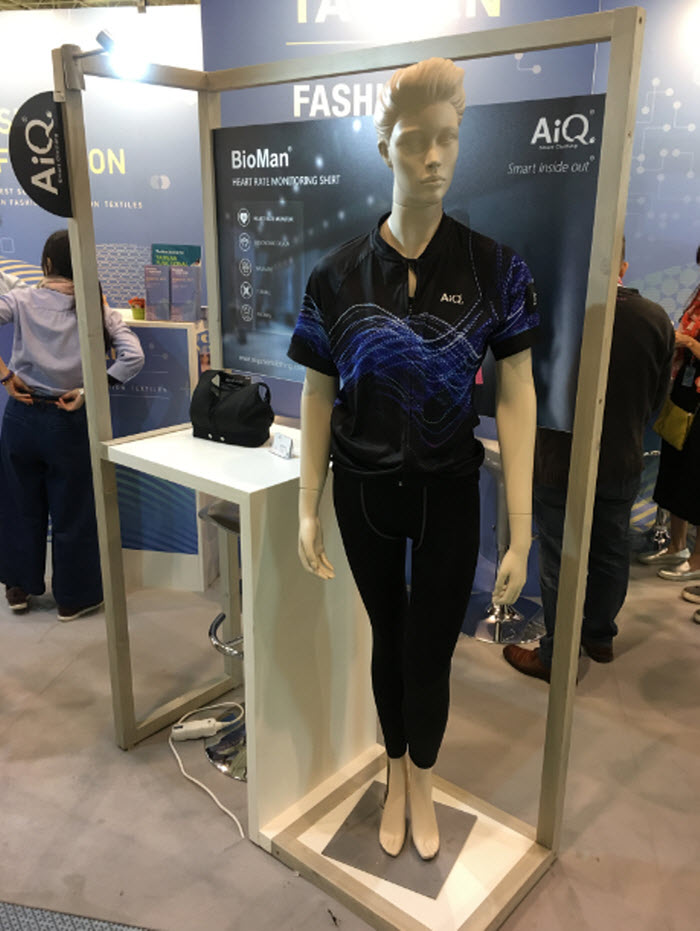
Taiwan’s AiQ is the sponsor of the Smart Clothing Challenge, part of the annual Wearable Technologies Innovation World Cup
CardioID Technologies is part of the CEiiA automotive engineering cluster based in Matosinhos, Portugal, and with an office in Lisbon, and its assistance system acquires electrocardiogram (ECG) signals from a driver’s hands to continuously detect drowsiness, cardiac health problems and biometric identity recognition, via the AiQ Smart Shirt.
It is specifically aimed at single drivers or those working in a remote location, with the cardiac signal acquired in real-time from the hands of a driver via the shirt, using a custom steering wheel cover equipped with special conductive elements, or gloves carrying out the same function for solitary workers.
After acquisition, the cardiac signal is processed locally, making use of advanced signal processing and machine learning algorithms to extract information related to drowsiness and fatigue. An alert is immediately issued to the driver if fatigue has been detected.
For fleets of vehicles, a dashboard aggregating geographically-referenced fatigue information is provided and CardioWheel can be extended with third party systems, such as Mobileye and Geotab.
Have your say. Tweet and follow us @WTiNcomment


