Cotton Futures were higher as traders consumed the USDA reports and Hurricane Michael moved into the Gulf of Mexico and production areas in Georgia and much of the rest of the Southeast. Some significant damage to crops is possible as bolls are open, but the system is moving fast and might not spend enough time in cotton areas to cause extensive damage. The harvest will be a bit slower in affected areas. Demand for US cotton has been poor for the last few weeks, and the lack of demand was hurting prices. China has been active in buying from India and will buy as much as possible to make up for production losses in China. Conditions have also improved in Pakistan as rains have been reported.
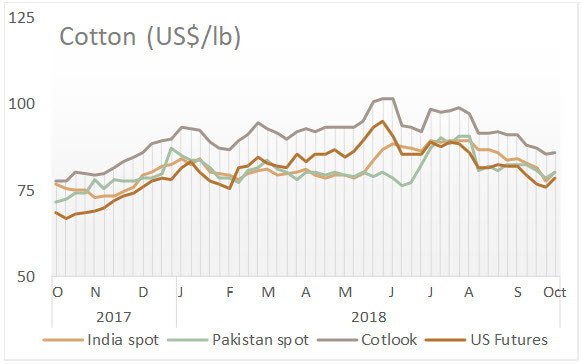
December contracts gained US cents 2.27 week-on-week to close at US cents 78.37 per pound, while March gained US cents 2.41 to finish at US cents 79.55, widening the premium over December by US cents 1.18. December 2019 also rose US cent 1.24 to close at US cents 76.99 per pound.
Global spot benchmark, the Cotlook A index rose US cent 0.80 on the week to close at US cents 86.15 per pound, having remained flat on the weekend.
In China, spot cotton markets extended weakness, seeing some on-call trades of old cotton. Prices for north-Xinjiang fresh cotton were heard at 15.40-15.60 Yuan a kg (US cents 101-102 per pound). The China Cotton Index continued to moderate this week by 101 Yuan, to close at 15,985 a ton (US cents 105 a pound, down US cent 1 from last week).
In Pakistan, cotton prices surged in the local market by around PakRs600-800 per maund due to depreciation in Pakistani currency. During the week, the Karachi Cotton Association increased the spot rate by PakRs700 to PakRs8,660 per maund ex-Karachi. Trading was mainly done for selective grades while buyers made deals for better grades on sellers’ asking price amid firm spot rate. Mills and spinners consolidated their long positions by concluding deals for second grade at a premium. Meanwhile, cotton harvest is expected around 11.5 million bales, implying a supply gap of about four million bales to meet consumption demand.
In India, spot prices were ruling higher than previous week by about INR1,100-2,000 per candy. Benchmark Gujarat Shankar-6 was traded at INR46,400 per candy, up INR1,600 from previous week. Cotton started arriving in markets of Gujarat this week, although delayed by a week. This with good demand from mills and higher minimum support price ensured that the new cotton season in opens at higher prices this year. Cotton prices are about 20% higher as compared to 2017-18 opening. Prices were at INR46,200-46,500 per candy this year, compared to INR38,500-39,000 per candy in the same period last year. Reports said that experts believe that prices may not fall in the near future, but instead, could rise. This trend is attributed negligible cotton stock at mills. Moreover, INR depreciation has made Indian cotton cheaper, which will encourage exports in coming days, and government’s hike for cotton MSP. All these factors have changed the sentiments in new season and as result, cotton prices have opened higher. Daily arrival has reached to around 55,000 bales for country as a whole, and around 10,000 bales in Gujarat.
Cotton yarn
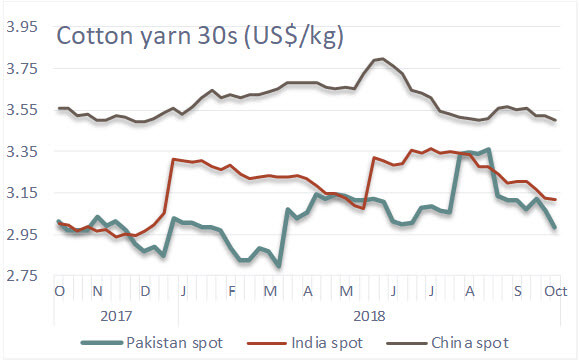
Cotton yarn markets in China saw thin liquidity this week, with prices going range-bound. Cotton yarn 21s and 32s continued to enjoy decent sales compared with other specs. In Shandong, it was reported that carded yarn sold relatively better than others. Imported yarn prices of India origin, however, inched down. 32s cotton yarn prices fell to 24.20 Yuan a kg (US$3.50 a kg, down US cents 2) while 40s felt to 25.30 Yuan a kg (US$3.66 a kg, down US cents 3). Coarser yarn prices of 16s were flat at 15.30 Yuan a kg (US$2.21 a kg) and 21s at 19.50 Yuan a kg (US$2.82 a kg, down US cents 3). Imported 32s yarn of India origin were offered at USS2.8 a kg (23.70 Yuan a kg).
In Pakistan, coarser count yarn in Karachi markets were dearer while others rolled over. In Faisalabad, cotton yarn prices were seen rising across counts reflecting the recent surge in cotton prices. However, sharply weakening currency pegged values down in US$ terms. 30s carded prices in Karachi were flat at PakRs168-170 per pound (US$2.83-2.86 a kg, down US cents 17 due to weak currency), while 32s combed in Faisalabad were up PakRs 6 at PakRs177.50-187.50 per pound (US$2.99-3.15, still down US cents 8 on weak PakRe).
In India, the cotton yarn price generally rolled over despite rising cotton prices. This implies that cotton prices may come down soon as fresh cotton starts entering the markets. 30s carded cotton yarn for knitting rolled were steady at INR230 a kg (US$3.12 a kg) in Coimbatore.