
The textile industry has generally continued to flourish with ever more cloth being woven in Britain. However, the uncertainties surrounding Brexit will persist until there is more clarity from the government. Investment in buildings, machinery and training continue in spite of these uncertainties.
This year, around 200 delegates attended the event held at the Cedar Court Hotel in Huddersfield, UK, on 4 October. The conference saw a range of presentations delivered by industry professionals from companies such as Karl Mayer, Cordura and Burberry.

Picanol and Burberry have both invested in virtual reality tools to assist with the training of their employees
After the conference, the annual dinner of The Weaving Group took place at the hotel with guest speaker Lydia Slack.
The event saw a total of 17 presentations, including technology explanations, insights into the UK economy and the challenges of the industry. The conference was opened by Rory Wilson, chairman of The Weaving Group, and then four sessions took place across the one-day biennial event.
‘People are our biggest asset’
One key theme that emerged from the event was the lack of skilled people within the industry. This theme was first highlighted by Simon Cotton, chief executive of Johnsons of Elgin. Cotton said that the company can now train and accredit apprentices, and currently 104 apprentices work at Johnsons.
“The latest technology is only as good as the people who are running it,” said Cotton during his presentation.
Tony Decock, sales manager at Picanol, also spoke of the lack of skilled people in the industry, stressing that many knowledgeable people in the sector are approaching retirement age and will need to be replaced over the next few years.
Picanol has recently launched its ‘Lets make it together’ campaign, or the ‘€1m per month campaign’ as Decock explained. The company has heavily invested in the permanent training of employees, employee infrastructure such as canteens and work spaces, new machinery, and virtual reality workroom training.
Burberry has undertaken a similar approach, focusing on employee empowerment, performance ownership, new and continuing professional development apprenticeship programmes and more, stating that “people are our biggest asset”.
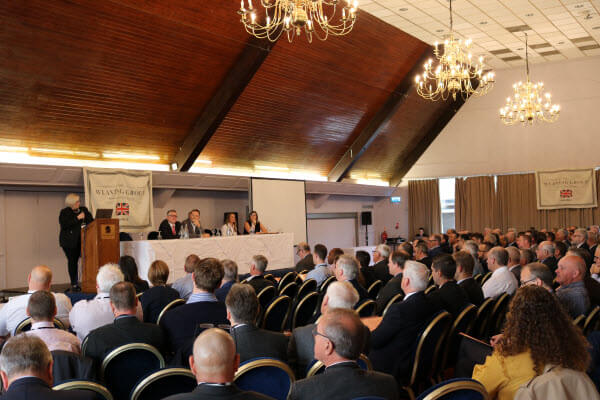
Around 200 delegates attended the event held at the Cedar Court Hotel in Huddersfield, UK, on 4 October
A greener industry
It is no secret that the textile industry is a hugely wasteful and polluting industry at present, however many companies are now focusing on their sustainability practices.
Dominique Baldeck, area sales manager at Itema, mentioned in his presentation that the company has recently introduced new waste-saving technologies – the iSaver and SelvedgeSaver. The iSaver eliminates left hand weft waste, while the SelvedgeSaver also reduces waste and can be used for a wide range of weft yarns. Baldeck explained that this year the company has tried to think much more about consciousness and responsibility.
In the news recently, Burberry announced it will stop burning unsold products in an effort to be a greener company, a fact that Richard Mason, senior manager for corporate responsibility at Burberry, reiterated during his presentation. Mason explained that Burberry is supposedly the first luxury clothing brand to be this transparent about its waste practices and now other companies are starting to think about their actions.
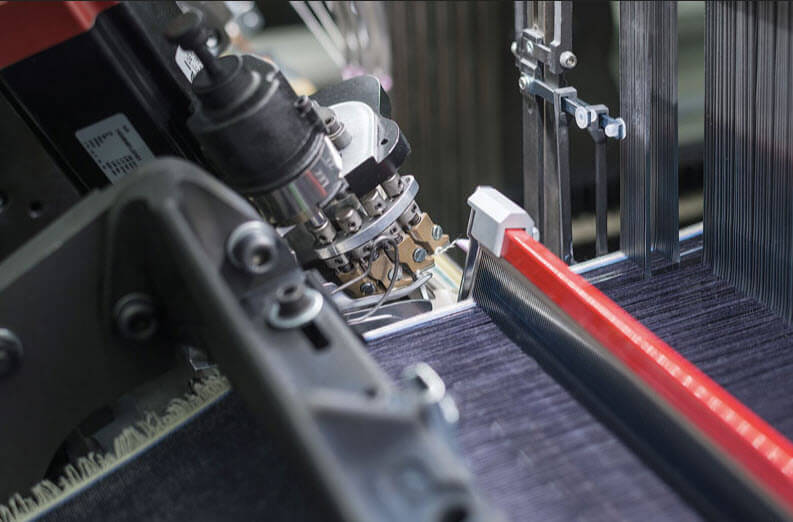
Itema's iSaver eliminates left-hand weft waste
Digitalisation
The conference also saw an emphasis on the latest technologies such as artificial intelligence (AI) and robotics.
Picanol and Burberry have both invested in virtual reality tools to assist with the training of their employees, and Picanol has also provided exoskeletons and cobots to workers to help overcome physical limitations such as lifting heavy loads.
Jonathan Eyre, technical head in advanced visualisation at AMRC Factory 2050, gave a presentation on a relatively new type of technology known as immersive digital twins.
“Digital twins virtually mimic a physical asset using real-time data … the concept is complex, but it is now coming together,” explained Eyre.
This pairing of the virtual and physical worlds allows analysis of data and monitoring of systems to head off problems before they even occur.
Luke Watkins, head of business development at Flexciton, gave an insightful presentation on how artificial intelligence can be used to optimise planning and scheduling in a weaving mill. Flexciton’s technology can help keep track of stock, visualise KPIs, change daily objectives and identify products that are overstocked and others that are neglected. The company is currently working with Burberry and Camira.
Industry 4.0 is happening now, so it is no surprise that most companies are embracing digitalisation to some degree, whether it be experimenting with robotics or introducing online customer portals.
Other presentations at the conference were delivered by representatives from Lloyds Bank, Comsat and Eltex, Dornier, the University of Manchester, Groz-Beckert, PTC, BMC, Make it British, Ushiwear and Prickly Thistle Scotland.
For more information about The Weaving Group, visit: http://www.theweavinggroup.co.uk/


