
It is known that ultraviolet radiation (UVR) is the main environmental risk factor causing different types of skin diseases and cancer, the most common cancer in humans. Studies in Australia suggest that 80% of skin cancers with the highest malignancy potential could be prevented by reducing sun exposure. One way to achieve this is by increasing the level of awareness among the population to understand the risks associated with sun exposure. However, population groups that are more exposed to this risk such as outdoor athletes and workers, should protect themselves using sunscreens that can offer variable levels of protection for a number of hours, alongside sun-protective garments that can provide skin protection, filtering the penetration of UV radiation.
Currently different national standards for evaluating the UV protection performance and labelling sun-protective clothing are being implemented in Australia, New Zealand, Europe and the US. These standards are mainly based on the Ultraviolet Protection Factor (UPF) of the fabrics – which is based on the transmission of UVR through a fabric, and the current standards vary on the minimum body surface area (BSA) required to be covered. Minimum body coverage requirements for the torso and limbs were added to some standards (eg European Union, 2003; Australia and New Zealand, 2017) but not others (eg the US).
This is despite recent evidence that has revealed clothing coverage is important in preventing some of the pigmented moles that develop in childhood, and the fact that industry has already reflected the need to protect the skin by covering a considerable proportion of the potentially exposed BSA.
In this product innovation profile, WTiN reports on a research outcome aimed at developing a new index for rating sun-protective clothing that incorporates garment design needs in relation to the BSA coverage of the garment in addition to the UPF of the fabric.
|
Purpose |
|
To develop a comprehensive index that can quantify the capability of sun-protective clothing and take into account both the BSA coverage achieved by the design of the garment and the UPF of the fabric itself. |
|
Approach |
|
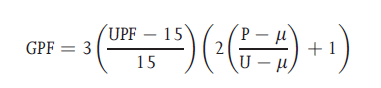
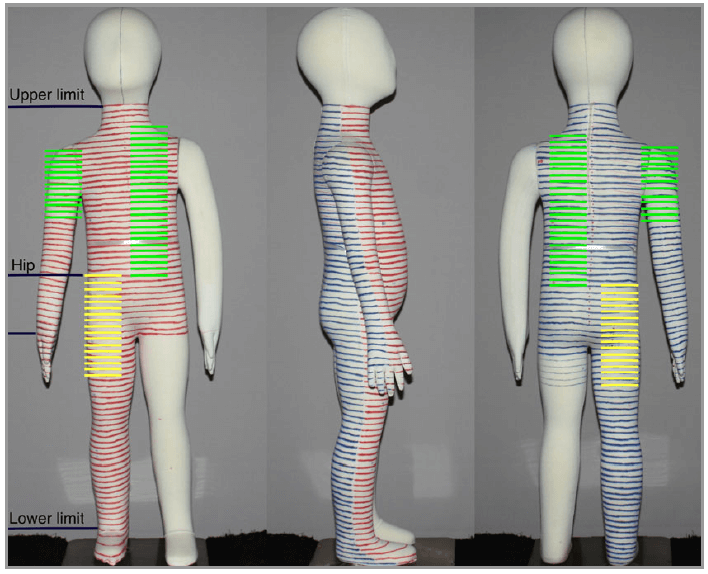
A mannequin model was fixed to an optical bench and marked with horizontal lines at 1cm intervals. An algorithm (the Garment Protector Factor; GPF) was developed and BSA coverage was determined based on the number of lines visible on a clothed versus an unclothed mannequin. The GPF can be determined using Equation 1, by including two linear variables for the UPF and relative BSA that is covered, and it can define if a protective clothing can meet or will exceed minimum international standards for sun-protective clothing. Equation 1 Where P is the number of surface contours protected/covered by a particular garment when the mannequin model is clothed, U is the maximum number of body contours defined in the BSA quotient for clothing of the relevant size and the number of body contours that must be covered by a garment to meet the minimum BSA standard is µ. The algorithm takes into account the age and size of the person and upper, lower or full body garment elements as well.
|
|
Results |
|
The GPF was designed to be consistent with the current Australian, New Zealand, European and US standards that evaluate and classify sun-protective clothing. According to the revised Australiana and New Zealand standard, the upper-body, lower-body and all-in-one garments are already categorised to either ‘meet’ the standard (minimum UPF 15), provide ‘good’ protection (minimum UPF 30) or ‘excellent’ fabric protection (UPF 50 or 50+). The new presented method combined BSA and UPF in a single equation for incorporation into future revisions of this and other standards, so that manufacturers of garments striving to incorporate higher UPF-rated textiles and designing garments covering more than the minimum specified BSA can achieve a higher categorical score. In the results of this research, three categorical scores were adopted to be consistent with AS/NZS 4399:2017. These three categories are: ‘minimum standard’ (0 ≤ GPF < 3); ‘good protection’ (3 ≤ GPF < 6); and ‘excellent protection’ (GPF ≥ 6) for garments that just meet the minimum BSA requirement but have progressively higher UPF ratings. The categories introduced here can also reward sun-protective garment designers by the application of Equation 1, whereby the gradient of GPF vs UPF increases as the protected BSA increases. |
|
Impact |
|
This designed sun-protective clothing index (GPF) could potentially be implemented universally in industry standards and could form a new rating system that has the potential to encourage fashion designers and manufacturers to design better sun-protective clothing that can be assessed (quantitatively) by taking into account both the UPF and the total protected BSA. This labelling system can also provide more information to the costumers about the benefits of garments that they are buying as to what extent they can protect the skin surface physically and practically. |
Reference
Stucki, et al., ‘A comprehensive approach to evaluating and classifying sun-protective clothing’, British Journal of Dermatology, 2018. DOI: 10.1111/bjd.15938
Copyright © 2018 British Association of Dermatologists