Read
Explore ideas, evidence and developments across the textile value chain.
Explore the archive
23,367 articles · latest first · 19,033–19,056
DAK Americas announces expansion of fibres business
DAK Americas, global PET producer, is increasing its polyester staple fibre capacity at its Cooper River plant near Charleston, SC.
 News16 Oct 2014
ICA announces new leadership team
The International Cotton Association’s (ICA) has announced its new leadership team, after election at its annual general meeting, held earlier this month during its Dubai 2014 trade event.
 News16 Oct 2014
DyStar reports increased emissions as production output rises 12%
DyStar’s carbon-dioxide emissions actually increased in 2013, the company admits in its annual Sustainability report. But it attributes the increase to a shift in the balance of its production towards a higher proportion of dyes, which involve higher energy-intensive manufacturing than textile chemicals. The company claims it reduced the intensity of emissions in both its dyestuff and chemical manufacture.
Itema exhibits rapier R9500 at two Turkish shows
Itema is to exhibit at two trade shows held in the south of Turkey, OTM in Gaziantep and KTM in Kahramanmaras. Itema, in partnership with Bilol agency, is exhibiting its rapier R9500 loom, launched two years ago and said to be responsible for a significant share of the Italian-headquartered company’s turnover.
BASF to divest global textile chemicals business to Archroma
Global chemical giant BASF is to sell its textile-chemicals business to Archroma, the company that was itself created by the divestment of the textile- and paper-chemicals business of Clariant.
H&M CEO talks fair living wages with Bangladesh government
Karl-Johan Persson, H&M CEO, met with the Minister of Commerce in Bangladesh, Tofail Ahmed, on October 14, requesting effective systems that regulate costs and prices in Bangladesh.
 News15 Oct 2014
Norafin celebrates IFF award win
Business solutions provider Norafin (Americas) Inc. has won an Industrial Fabrics Foundation (IFF) award for its performance-engineered Komanda product.
Low & Bonar feeling effects of ‘subdued’ European construction market
European construction sales at UK-based global performance materials group Low & Bonar remain subdued, according to its latest trading statement.
Fisher Textiles becomes HEYTex distributor
US-based Fisher Textiles has announced its appointment as an authorised distributor for the HEYTex brand of digitally printable textiles in North America and says it is now stocking all digitex sign materials.
 Review15 Oct 2014
Second annual edition of Fashion SVP to be held from 2016
Fashion SVP has announced that a second annual edition of the event will take place from March 2016 due to the success of the event so far and high demand from buyers and suppliers.
 News15 Oct 2014
Wacker introduces new silicone impregnants
Wacker Chemie is presenting two new silicone impregnants this week, at the 61st SEPAWA Congress in Fulda, Germany.
Teijin Aramid ups Twaron aramid product prices
Teijin Aramid will raise prices for its Twaron products by 7% insofar as existing contracts allow. This is the first time since 2008 the company has announced a general price increase.
Mantex launches Digital Density Disruptor
Indonesia-based Mantex Technologies has introduced a Digital Density Disruptor, said to improve yarn package dyeing consistency for sewing threads.
 Insight15 Oct 2014
CmiA supports women in cotton-growing regions to help combat rural poverty
Cotton Made in Africa (CmiA)’s Aid by Trade Foundation (AbTF) provides women in the CmiA cotton-growing regions with the opportunity to gain equal access to education, economic independence through training and financial support.
Exhibitors focus on eco products at Yarn Expo Autumn 2014
Yarn Expo Autumn 2014, to be attended by nearly 150 overseas and domestic yarn suppliers, will open its doors on Monday, October 20 in Shanghai, China.
 News15 Oct 2014
IVL attracts investors with company-focused seminar
Indorama Ventures Public Company Limited (IVL) held a seminar on ‘Understanding IVL’ at the Stock Exchange of Thailand Building on 13 October 2014, hoping to build understanding about the company for potential investors and analysts.
 Profile15 Oct 2014
Contifibre celebrates 20 years of production in France
Contifibre has celebrated 20 years of production in France. At an evening event held recently, 100 representatives of customers from across France and Belgium enjoyed a dinner and catwalk show charting the history of women’s lingerie and hosiery from the 1800s to the latest trends for coming seasons.
Quicksilver takes next step in leadership transfer
Bob McKnight will retire as a senior executive of Quiksilver on October 31, and the company has elected Andy Mooney as chairman and Pierre Agnes as president effective November 1. Mr McKnight will remain a director of Quicksilver.
Addressing hidden supply chain costs
Hidden costs in the textile and clothing supply chain and managing risk were key topics at yesterday’s Association of Suppliers to the British Clothing Industry conference held in Leeds, UK. While securing suppliers that can deliver the required quality at the right time and price is the goal of most buyers, being too focussed on achieving the lowest price in negotiations can have unintended consequences. These include missed opportunities to sell due to long delivery times from distant manufacturing destinations, quality and compliance issues. Lack of trust between buyer and seller can lead to corners potentially being cut with the resultant effect on quality, which can undermine customer satisfaction, leading to further lost sales. Non-compliant factories may be exposed by the media leading to undermining of customer trust in the retailer and lost sales. It is of concern that some retail buyers are proud of the fact that they regularly change supplier, possibly even annually. While it is important to review suppliers to ensure efficient running of the retail business and maximise margins, such a strategy or regular change means suppliers are unlikely to build a collaborative relationship and go the extra mile. As competitive pressure grows for faster and faster delivery times, a good relationship with suppliers and other stakeholders in the textile and clothing supply chain can be vital in achieving these. Technology also has an important part to play in improving efficiency of the supply chain. It is increasingly possible to monitor where a consignment of goods is in the world and more accurately forecast delivery time. Software is available that covers aspects of the supply chain including yarn development, product planning and design, production and sales promotion. Virtual sampling, for example, has the potential to significantly cut sampling times, facilitating faster delivery of product to market. As labour costs rise, there is also a school of thought that investment in textile machinery, particularly ways to automate processes currently done manually, will grow and textile manufacturing could become more akin to automotive manufacturing, for example. In an increasingly competitive market, retailers undoubtedly need to look at their hidden costs and with an increasingly complex global scenario, software seems increasingly necessary in order to be able to do this. Where suppliers have the technology and know-how, they could also communicate these to retailers, emphasising where they add value, as part of their marketing strategy.
Solvay signs ICCA responsible care charter
Solvay has ascribed to the new International Council of Chemical Associations (ICCA) Responsible Care Global Charter, which reinforces the commitment of multinational chemical companies to continuously improve their health, safety and environmental (HSE) performance worldwide.
 News14 Oct 2014
Kiian to launch fluorescent sublimation inks at SGIA
Kiian Digital will launch its vivid pink, yellow and green fluorescent transfer sublimation inks as part of its Digistar range at SGIA in Las Vegas, USA, from October 22-24. This collection of inks is designed for attention-grabbing graphics on sportswear and other textile printing applications.
 Review14 Oct 2014
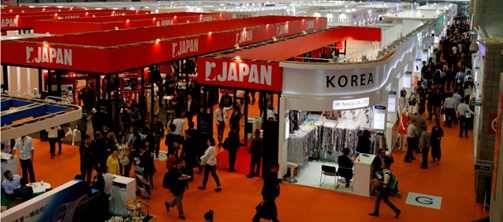
Record exhibitor number for Intertextile Shanghai Apparel Fabrics
Intertextile Shanghai Apparel Fabrics – Autumn Edition 2014 will reach a new record number of exhibitors, with over 3,800 from 30 countries and regions confirmed to partake in the fair’s 20th anniversary edition.